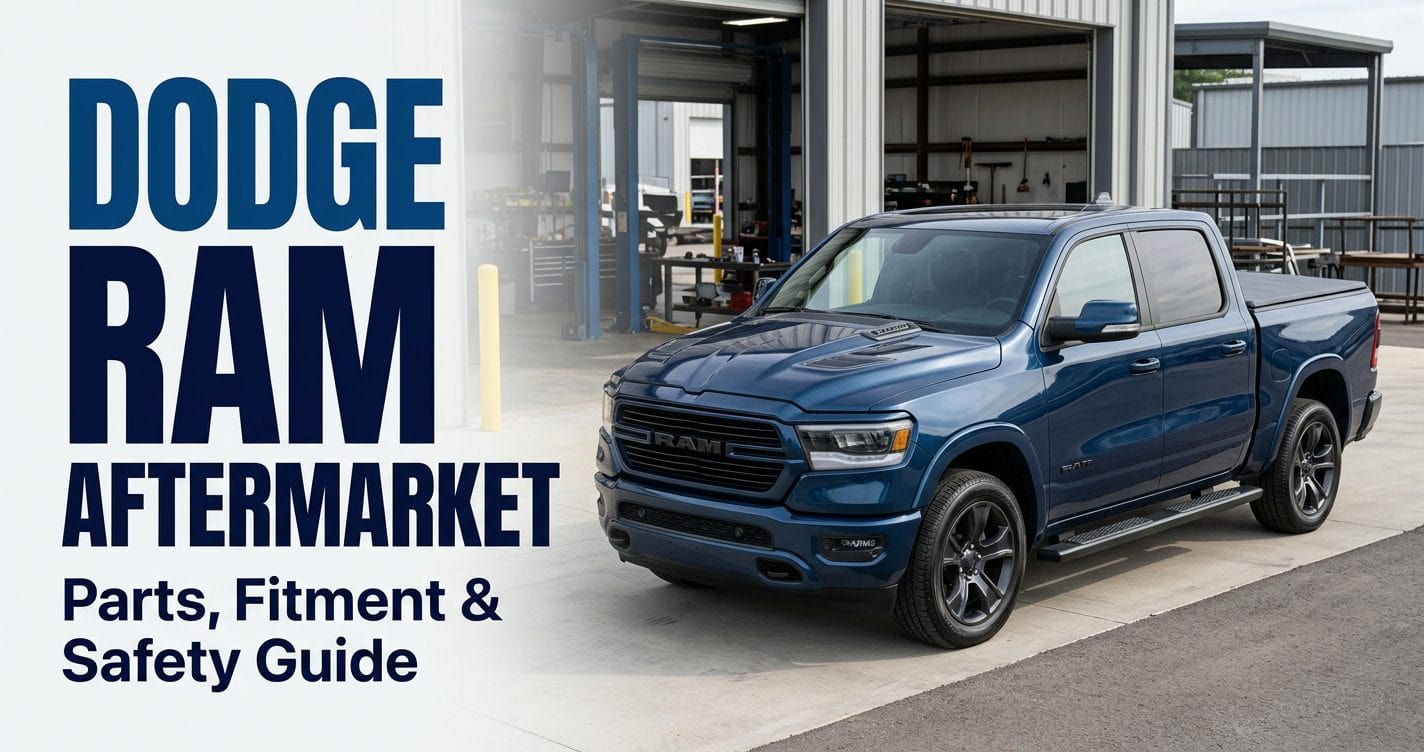
Dodge Ram aftermarket parts give truck owners more ways to repair, personalize, and improve their vehicles beyond the original factory setup. These parts range from simple floor liners and bed covers to suspension components, replacement lights, exhaust systems, and performance upgrades.
But adding something new to a Ram truck isn’t always as simple as choosing a part that looks right. Model year, engine, trim, cab style, drivetrain, electrical systems, and intended use can all affect compatibility.
Understanding the Dodge Ram aftermarket helps you make informed decisions, avoid installation problems, and choose modifications that make sense for your truck. This guide explains the main categories, the differences between OEM and aftermarket parts, common compatibility concerns, and the checks worth making before modifying your vehicle.
Key Facts About the Dodge Ram Aftermarket
- Aftermarket parts are manufactured by companies other than the vehicle’s original equipment supplier.
- Available options include replacement components, exterior accessories, interior upgrades, suspension parts, and performance modifications.
- Compatibility depends on the truck’s specific year, model, configuration, and existing equipment.
- A lower purchase price doesn’t automatically mean better long-term value.
- Electronic accessories and major mechanical modifications require extra attention to installation and system compatibility.
- Aftermarket modifications can affect warranty coverage for related damage or repairs.
- Emissions rules and vehicle safety requirements still apply to modified trucks.
What Does Dodge Ram Aftermarket Mean?
The term aftermarket describes the market for vehicle parts, accessories, and equipment made or supplied outside the original factory installation process.
For a Ram owner, that might mean buying a replacement mirror from an independent manufacturer, adding a tonneau cover, installing upgraded shocks, or replacing a worn component with an alternative part.
Aftermarket products serve different purposes. Some are intended to replace a failed component. Others add a feature the truck didn’t originally have. Performance modifications aim to change how the vehicle responds, sounds, handles, or operates.
It’s also important to distinguish aftermarket parts from genuine Mopar parts. Mopar is the official parts and service brand associated with Chrysler, Dodge, Jeep, and Ram vehicles. Genuine Mopar parts are designed for applicable vehicle specifications, while independent aftermarket products vary by manufacturer and application.
Neither the word aftermarket nor a premium price tells you everything about a part’s quality. The manufacturer’s specifications, testing, fitment information, warranty, and installation requirements matter more.
Why Ram Owners Consider Aftermarket Upgrades
Truck owners don’t all use their vehicles in the same way. A Ram 1500 used for commuting and family trips has different needs from a Ram 2500 used for demanding work or a truck regularly driven on rough trails.
Some modifications address everyday inconveniences. A set of fitted floor liners can make muddy footwear easier to manage, while a bed cover can help protect cargo from weather and keep items less exposed.
Other changes focus on access and usability. Running boards can make climbing into a tall truck easier. Bed storage systems can help keep tools organized, and towing accessories can support a properly configured trailer setup.
Appearance is another reason people modify their trucks. Wheels, grille replacements, exterior trim, and lighting can change a Ram’s overall look.
For more ideas, read our guide to Dodge Ram 1500 daily driver accessories.
The important distinction is between a modification that solves a real problem and one that introduces extra cost or maintenance without delivering much practical value. Before choosing a part, identify what you want to improve and how that change will affect your truck’s everyday use.
Common Types of Dodge Ram Aftermarket Parts
Aftermarket products generally fall into several categories. Knowing the category helps you understand which compatibility and installation checks matter most.
Exterior and bed accessories
This group includes tonneau covers, bed liners, running boards, fender flares, grille replacements, tailgate accessories, and tool storage. These products often focus on cargo protection, accessibility, appearance, and convenience.
Check the bed length, cab configuration, mounting locations, and any existing accessories before selecting a part.
Interior accessories
Floor mats, seat covers, organizers, phone mounts, and storage accessories can make a truck more comfortable and easier to maintain.
Interior products still need to fit correctly. In particular, floor mats must not interfere with the accelerator or brake pedal, and accessories must not obstruct the driver’s view or access to controls.
Suspension, wheels, and tires
Leveling kits, lift kits, shocks, springs, wheels, and tires can change ground clearance, ride quality, handling, and vehicle dimensions.
These are not purely cosmetic changes. Suspension geometry, steering components, brake lines, tire clearance, and wheel specifications may all be relevant. A modification can also affect towing behavior and vehicle stability.
Replacement and performance components
Aftermarket replacement parts may include filters, alternators, brake components, cooling-system parts, and other service items. Performance products may include intake systems, exhaust components, and engine-related upgrades.
For these parts, material quality, correct specifications, installation procedures, and compliance with applicable regulations deserve particular attention.
Electrical and lighting accessories
LED lights, auxiliary lighting, cameras, audio equipment, and other electronic accessories can add useful features. However, incorrect wiring, excessive electrical loads, poor connections, or incompatible electronics may create faults.
If a truck develops warning lights, unexpected battery drain, or electrical problems after an installation, inspect the modification as part of the diagnosis rather than assuming the original vehicle component has failed.
OEM vs. Aftermarket vs. Used Parts
The best option depends on the job, the part’s condition, the available documentation, and your tolerance for installation or compatibility risks.
| Option | Main advantage | Important consideration |
|---|---|---|
| Genuine OEM/Mopar | Designed for specified vehicle applications | Confirm the correct part number and applicable warranty |
| Aftermarket | Broad choice of designs, features, and specifications | Quality and fitment vary by manufacturer and product |
| Used or salvaged | May offer a lower upfront cost | Check wear, damage, history, and compatibility |
| Remanufactured | Can provide a rebuilt alternative to a new component | Review the rebuilding standard and warranty terms |
Genuine parts can be a sensible choice for components where factory compatibility is especially important. Aftermarket products can be appropriate when a reputable manufacturer provides clear application data and the part meets the truck’s requirements.
Used components require extra care because their condition and service history may be uncertain. For safety-critical parts, have a qualified technician assess whether a used component is suitable.
You can compare factory applications through the official Mopar Ram parts catalog. Its vehicle-selection tools can help narrow the search by model and configuration.
How to Check Compatibility Before Installing a Part
Compatibility is one of the biggest concerns when choosing Dodge Ram aftermarket parts. Two trucks with the same model name may use different components because of their model years, engines, trim levels, or factory options.
Start with the following checks.
1. Confirm the model year and configuration. Record the model year, model, trim, engine, cab style, bed length, and two-wheel-drive or four-wheel-drive configuration where relevant.
2. Use the VIN when appropriate. A vehicle identification number can help a parts supplier identify the correct application. It is especially useful when factory options or production changes affect compatibility.
3. Check the part number and application notes. Don’t rely on a product title that simply says it fits a Ram 1500. Read the exact year range, exclusions, required hardware, and installation notes.
4. Check related components. Wheels need suitable dimensions and clearances. Suspension upgrades may require additional components or alignment. Electrical accessories may require specific connectors, relays, fuses, or programming.
5. Confirm the return policy and warranty. Ask what happens if the part doesn’t fit or a required component is missing. Keep receipts and installation records.
For a broader overview of accessory options, see Best RAM 1500 Accessories.
Common Problems With Aftermarket Ram Modifications
An aftermarket part can be suitable for a truck and still cause problems if it is poorly designed, incorrectly selected, or installed improperly.
Poor fitment
A bumper, grille, mirror, or bed accessory may not line up with factory mounting points. Forcing a part into position can damage fasteners, wiring, trim, or surrounding bodywork.
Check the installation instructions before removing factory components. If the mounting points or connectors don’t match the instructions, stop and confirm the application.
Electrical faults
Accessories that draw power or connect to vehicle electronics can cause trouble when wiring is incorrect. Poor grounds, loose connectors, and unsuitable power connections can contribute to intermittent faults or battery drain.
If electrical symptoms begin after an installation, document when the issue started and have the wiring inspected. Our guide to Ram electrical problems and possible fixes provides additional background on electrical troubleshooting.
Changes to handling and ride quality
A lift or leveling kit may change the truck’s center of gravity, suspension geometry, steering response, and alignment requirements. Larger wheels and tires can also change clearance and the way the vehicle behaves.
Have suspension and steering modifications checked by a qualified installer. Confirm alignment requirements and make sure the final setup remains appropriate for the vehicle’s intended use.
Unexpected performance or warning-light issues
An intake, exhaust, or electronic modification may affect sensors, engine management, or emissions equipment. A check-engine light after installation should be diagnosed rather than ignored or cleared without identifying the cause.
For engine-related troubleshooting, see 5.7 Hemi Ram 1500 cold air intake: troubleshooting and fitment guidance.
Owner discussions on Reddit also show why installation planning matters. In one Ram truck owner discussion about aftermarket installations, participants described how shop policies and installation arrangements can vary. Treat these accounts as individual experiences, not a guarantee of what every repair shop will do.
Warranty, Safety, and Legal Considerations
Before modifying a newer truck, read the warranty terms that apply to your specific vehicle. Installing a non-factory part does not automatically cancel every part of a vehicle warranty. However, coverage for a repair may be affected when an aftermarket component or its installation causes the damage.
The official Mopar warranty information explains that coverage depends on the applicable warranty terms. Keep documentation for the parts used and any professional installation work.
Emissions-related changes deserve particular care. Federal law and state regulations can restrict tampering with emissions-control equipment. A performance product advertised for off-road use may not be legal for use on public roads in every jurisdiction. Check the product’s certification and the rules that apply where the truck is registered and driven.
Safety matters just as much. Avoid modifications that interfere with airbags, seat belts, lighting requirements, driver visibility, braking, steering, or advanced driver-assistance sensors.
If an upgrade changes towing equipment, suspension, tires, or vehicle dimensions, confirm that the truck remains suitable for its intended loads and operating conditions. Never assume that a modification increases the truck’s rated towing or payload capacity.
A Practical Checklist Before You Modify Your Ram
Before installing an aftermarket part, work through this checklist:
- Define the purpose of the modification.
- Verify the exact truck configuration and part application.
- Review installation instructions and required tools.
- Check warranty terms, return conditions, and product documentation.
- Confirm emissions compliance and applicable local requirements.
- Consider whether professional installation is appropriate.
- Keep receipts, part numbers, and installation records.
- Inspect the installation and test the vehicle safely afterward.
Start with simple changes that solve a real need. More involved suspension, brake, engine, and electrical modifications deserve additional research and, when appropriate, professional installation.
What Dodge Ram Aftermarket Choices Mean for Owners in 2026
The range of replacement parts and accessories gives Ram owners more ways to tailor their trucks to work, commuting, towing, and recreation. At the same time, newer vehicles can have complex electronics, sensors, and factory-integrated features that make compatibility more important.
That doesn’t mean every aftermarket part is risky or that factory parts are always the only reasonable choice. It means the decision should be based on evidence about the specific component, the vehicle application, and the intended use.
For older trucks, availability and condition may be important considerations. For newer models, precise fitment, electronic integration, warranty terms, and emissions compliance may deserve more attention.
Before choosing an upgrade, compare the manufacturer’s documentation with your truck’s requirements. A carefully selected part that fits correctly and serves a clear purpose is more useful than a modification chosen only for its appearance or advertised performance.
Final Thoughts
The Dodge Ram aftermarket offers practical ways to maintain, customize, and improve a truck, but the right choice depends on compatibility, quality, safety, and intended use. Check the exact application, understand the installation requirements, and review warranty and legal considerations before making changes.
The most useful upgrade is one that solves a real problem without creating new ones. Research the part, verify the fit, and make sure the finished modification works with your Ram rather than against it.






0 Comments