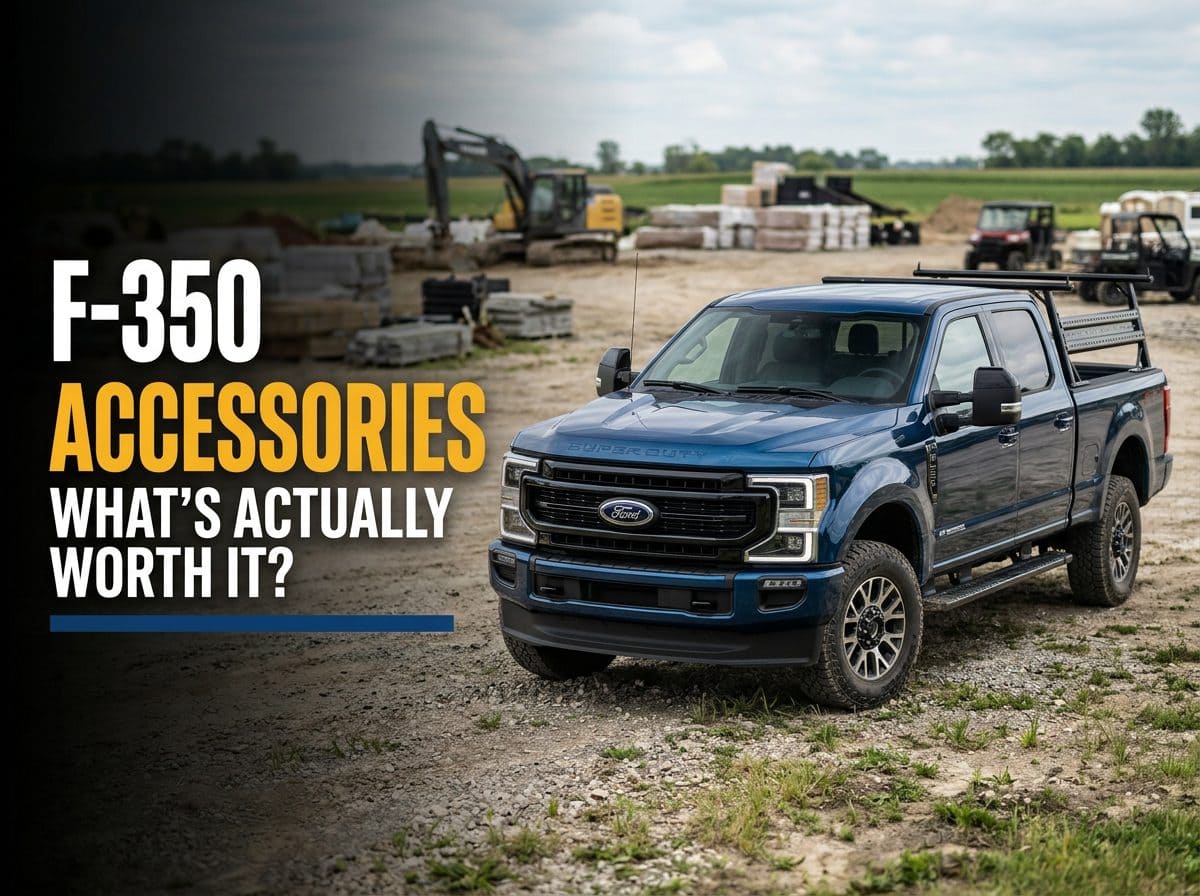
From bed protection to towing gear, learn what fits your F-350, what can affect payload, and why model year matters before adding accessories.
A Ford F-350 Super Duty is built to handle serious work. It might pull a fifth-wheel camper across several states, haul construction materials during the week, and serve as the family truck on the weekend.
That’s exactly why choosing the right Ford F-350 truck accessories deserves more thought than simply picking something that looks good. An accessory can make everyday driving easier, protect expensive truck components, or improve cargo organization. But the wrong modification can also create fitment problems, add unnecessary weight, or interfere with towing equipment.
In 2026, Super Duty trucks offer impressive capability and increasingly sophisticated technology. Owners need to think about how accessories work with the truck rather than treating every upgrade as an isolated addition.
Let’s look at the accessories that matter, what has changed, and what Ford owners should understand before modifying their trucks.
- F-350 accessories include bed protection, lighting, storage, towing equipment, interior upgrades, and suspension components.
- Model year matters. Many 2017–2022 parts do not fit 2023 and newer Super Duty models.
- SRW and DRW trucks can require different mud flaps, wheel accessories, and exterior components.
- Heavy accessories reduce the payload available for passengers, cargo, and trailer pin weight.
- Aftermarket electronics must be installed carefully to avoid electrical problems.
- The right accessory depends on how you actually use your F-350.
What Are Ford F-350 Truck Accessories?
Ford F-350 truck accessories are additional components or equipment designed to improve the truck’s functionality, comfort, protection, appearance, or towing experience.
Some are available through Ford’s genuine accessory program. Others come from independent aftermarket manufacturers specializing in heavy-duty truck equipment.
These accessories range from inexpensive floor mats to more involved additions such as suspension components, auxiliary lighting, bed storage systems, and fifth-wheel towing equipment.
For example, a contractor might prioritize a secure toolbox and durable bed protection. Someone who owns a large camper may be more interested in hitch compatibility, trailer wiring, and suspension support.
Both owners have an F-350, but their accessory needs are completely different.
Popular F-350 accessory categories
- Bed accessories: Bed liners, bed mats, tonneau covers, toolboxes, and cargo racks.
- Exterior accessories: Running boards, mud flaps, fender protection, grille guards, and bumpers.
- Interior accessories: All-weather floor liners, seat covers, storage organizers, and console accessories.
- Towing accessories: Fifth-wheel hitches, gooseneck equipment, trailer wiring, and towing mirrors.
- Performance and suspension: Shocks, leveling systems, air springs, and compatible wheel and tire upgrades.
- Electrical accessories: Auxiliary lighting, dash cameras, power outlets, and communication equipment.
The important distinction is that an accessory should improve something specific. Adding equipment without considering its purpose can make a truck heavier and more complicated without making it more useful.
Why F-350 Accessories Matter More in 2026
Modern heavy-duty trucks are expected to do more than ever. Many owners use the same vehicle for towing, business, road trips, outdoor recreation, and everyday transportation.
That creates a growing need for accessories that support different jobs without compromising the truck’s original capabilities.
1. Modern trucks have more equipment to protect
Today’s Super Duty models include sophisticated electronic systems, cameras, sensors, integrated towing technology, and advanced interior features.
Adding equipment around these systems requires care. A poorly positioned bumper, incorrectly installed lighting system, or unsuitable wiring connection can interfere with components that were designed to work together.
2. Owners expect more from their truck beds
Truck beds are no longer just open spaces for throwing tools and materials. Many owners want organized storage, weather protection, easier cleaning, and better cargo control.
That explains the growing popularity of tonneau covers, bed mats, storage systems, and racks.
Ford’s own accessory catalog includes bed products, cargo organizers, floor liners, storage equipment, and towing accessories. You can explore the official Ford Accessories catalog to see the available categories.
3. Towing equipment needs to match the actual truck
The 2026 Super Duty lineup demonstrates how much capability can vary between configurations.
Ford advertises up to 40,000 pounds of maximum available towing across the Super Duty lineup, but this is a properly equipped maximum, not a rating that every F-350 can achieve.
Engine, axle ratio, cab configuration, drivetrain, towing equipment, vehicle weight, and passenger load all matter.
That is why accessories should be selected around the truck’s actual ratings rather than impressive numbers advertised for the model family.
Understanding 2026 Super Duty Engine and Capability Differences
The 2026 Super Duty engine lineup illustrates why F-350 owners should understand their truck’s exact configuration before making modifications.
The following figures represent Ford’s published maximum available figures across the Super Duty pickup lineup. They are not specifications guaranteed for every F-350 configuration.
| Engine | Horsepower | Torque | Maximum available towing | Maximum available payload |
|---|---|---|---|---|
| 6.8L Gas V8 | 405 hp | 445 lb-ft | 18,900 lbs. | 8,000 lbs. |
| 7.3L Gas V8 | 430 hp | 485 lb-ft | 22,500 lbs. | 7,635 lbs. |
| 6.7L Power Stroke Diesel | 475 hp | 1,050 lb-ft | 38,600 lbs. | 6,952 lbs. |
| 6.7L High Output Power Stroke | 500 hp | 1,200 lb-ft | 40,000 lbs. | 6,935 lbs. |
On mobile, touch and swipe left or right across the table. On desktop, drag the horizontal scrollbar beneath it to view all columns.
These numbers tell an interesting story. The highest towing figure and highest payload figure do not necessarily belong to the same engine configuration.
And adding accessories changes the vehicle’s available carrying capacity. That’s an important detail for owners who plan to install heavy bumpers, winches, racks, toolboxes, or other equipment.
Which Ford F-350 Accessories Are Worth Understanding?
1. Truck bed liners and bed mats
The bed is one of the hardest-working areas of an F-350. Gravel, lumber, construction tools, equipment, and outdoor gear can quickly leave scratches, dents, and damaged surfaces.
Bed protection generally comes in three forms:
- Spray-in liners: A protective coating applied to the truck bed. It provides a textured surface and protects against everyday wear.
- Drop-in liners: A fitted plastic liner that offers physical coverage and can be replaced when damaged.
- Rubber bed mats: A removable layer that helps reduce cargo movement and provides a more comfortable surface when working inside the bed.
There isn’t one perfect solution for everyone.
A recent discussion on the Ford Truck Enthusiasts forum about F-350 bed protection highlighted the trade-offs between drop-in liners, rubber mats, and fitted bed protection.
Some owners value easy cleaning and complete coverage. Others prefer a removable mat that makes it easier to work inside the bed.
The practical lesson is simple: think about what you carry before deciding how to protect the surface.
2. Tonneau covers and truck bed storage
A tonneau cover helps protect cargo from weather and reduces how exposed equipment is when the truck is parked.
F-350 owners have several basic cover styles to consider:
- Soft roll-up covers for flexible access and relatively simple construction.
- Hard folding covers for a more rigid bed covering.
- Retractable covers for convenient access along the bed rails.
- Fiberglass bed caps for enclosed cargo storage.
But there is one important detail for Super Duty owners: a cover must work with the equipment already installed in the truck.
A toolbox, bed rack, fifth-wheel hitch, gooseneck system, or factory bed accessory can affect how a cover fits. Some combinations require additional clearance or a different mounting arrangement.
Before selecting a cover, identify the bed length, bed rail arrangement, and towing equipment.
Our Ram 1500 bed cover guide explains similar differences between cover designs, weather protection, cargo access, and fitment. The fitment details are Ram-specific, but the general considerations are useful when understanding pickup bed covers.
3. Running boards and side steps
The F-350 sits higher than many everyday vehicles. Getting into the cab can be inconvenient, especially for children, older passengers, or people who climb in and out throughout the workday.
Running boards, nerf bars, and retractable steps offer different ways to improve access.
Fixed running boards provide a consistent stepping surface. Nerf bars are usually narrower and offer a different appearance. Retractable steps move out of the way when the doors are closed.
Before installation, check mounting locations, ground clearance, and compatibility with aftermarket suspension equipment.
4. Fifth-wheel and gooseneck towing accessories
For people who tow large campers, livestock trailers, or equipment trailers, this category deserves special attention.
Fifth-wheel and gooseneck systems use different connection arrangements. Both place substantial loads into the truck, and their installation must match the vehicle’s equipment and weight ratings.
Some Super Duty trucks come with factory-installed bed preparation systems. Others require additional equipment.
Ford’s 2026 towing guide explains that conventional trailer tongue weight generally accounts for 10% of loaded trailer weight, while fifth-wheel and gooseneck pin weight generally accounts for 15%.
That weight counts against the truck’s available payload, along with passengers and cargo.
For example, adding a heavy toolbox, auxiliary fuel tank, or other equipment can reduce the remaining capacity available for a trailer’s pin weight.
Do not assume that a heavy-duty truck automatically has unlimited carrying capacity.
5. Mud flaps, fender protection, and exterior accessories
Driving an F-350 on gravel roads, construction sites, or muddy trails can expose its bodywork to rocks, mud, and road debris.
Mud flaps help reduce material thrown toward the body and other vehicles. Fender liners provide additional protection inside the wheel areas.
Here, the single-rear-wheel and dual-rear-wheel distinction matters.
A dually F-350 has different rear-wheel coverage and exterior clearance requirements. Mud flaps and certain wheel-area accessories must be designed for the appropriate configuration.
Also pay attention to bumper-mounted sensors, cameras, and lighting when considering exterior modifications.
6. Interior floor liners and storage accessories
Most F-350 owners spend plenty of time inside the truck. Whether it is used for commuting, job-site travel, or long-distance towing, protecting the interior makes a difference.
All-weather floor liners help contain water, dirt, sand, and mud. Seat protection can reduce wear, while console organizers make small tools and everyday items easier to find.
These upgrades aren’t necessarily exciting, but they can make an older truck’s interior easier to maintain.
For additional ideas about protecting and organizing a pickup cabin, see our guides to daily-driver truck accessories and interior comfort and storage modifications. These articles cover Ram-specific applications, not Ford fitment.
7. Suspension, wheels, and tire upgrades
Suspension modifications are popular among heavy-duty truck enthusiasts. Leveling systems, replacement shocks, air springs, and larger tires can change how a truck looks and behaves.
However, these modifications need careful planning.
A leveling kit can change suspension geometry and ride characteristics. Larger tires may affect clearance, steering, speedometer readings, and braking performance.
Air springs are another commonly discussed addition for towing. They can help manage rear suspension sag when properly selected and adjusted.
But remember: air springs do not increase the truck’s factory GVWR, GAWR, tire ratings, or legal payload capacity.
In a recent Reddit discussion about F-350 upgrades for fifth-wheel towing, owners shared different experiences with air springs, factory overload springs, and towing setups.
One useful takeaway was that additional suspension equipment isn’t automatically necessary for every towing situation. The right setup depends on the load and the truck’s existing suspension configuration.
8. Auxiliary lighting and electrical accessories
Work trucks and recreational vehicles often benefit from additional lighting.
Bed lights, properly aimed auxiliary driving lights, work lights, and backup lighting can improve visibility when working after dark.
However, modern Super Duty electrical systems should not be treated like simple wiring projects.
Additional lights, compressors, cameras, and electronic accessories draw power. Incorrect connections, unsuitable wiring, or poorly planned installations can create problems with battery performance and other electrical systems.
Ford’s 2026 owner’s manual specifically warns that non-Ford electrical and electronic accessories can adversely affect battery performance and durability, as well as other vehicle electrical systems.
Choose properly rated components and use a qualified installer for more complicated electrical work.
2017–2022 vs. 2023–2026 Ford Super Duty: Why Fitment Matters
One of the biggest mistakes truck owners make is assuming that an accessory fitting one F-350 will automatically fit every other F-350.
The 2023 model year brought a redesigned Super Duty generation. That means exterior appearance parts, lighting, interior organizers, and several body-specific accessories require closer attention to model-year compatibility.
| Fitment factor | 2017–2022 Super Duty | 2023–2026 Super Duty |
|---|---|---|
| Body generation | Previous Super Duty generation | Redesigned fifth-generation Super Duty |
| Exterior styling | Previous grille, hood, and lighting designs | Updated front-end and exterior styling |
| Lighting accessories | Must match the earlier headlight and lamp designs | Verify compatibility with the newer lamp and front-end design |
| Interior accessories | Must match the earlier dashboard and console layout | Check updated cabin and console configurations |
| Bed equipment | Verify exact box size and mounting arrangement | Verify the updated box, bed rail, and factory equipment configuration |
| General compatibility | Use the product’s specified 2017–2022 fitment range | Look for an explicitly listed 2023–2026 application |
Swipe the table horizontally on mobile or drag the scrollbar underneath to compare both generations.
This comparison is a fitment guide, not a claim that every accessory changed in 2023. Some universal equipment and certain shared components may span multiple generations.
Always check the manufacturer’s exact application information before installation.
What Ford Owners Are Saying About F-350 Accessories
Owner communities can reveal issues that aren’t always obvious in product descriptions.
For example, a 2025 F-350 owner on Ford Truck Enthusiasts asked about bed protection after hauling materials such as dirt, gravel, metal scrap, and lumber.
The discussion included different experiences with drop-in liners, spray-in coatings, and removable bed mats. Owners highlighted practical concerns such as cleaning, cargo movement, and protecting the bed surface.
Another discussion in the same community explored the use of factory spray-in liners with additional removable mats. Some owners liked the extra protection and comfort when working inside the bed.
You can read these discussions here:
- F-350 bed protection discussion
- Ford Super Duty bed mat discussion
- 2023 F-350 owner modifications and suspension experiences
One recurring theme is that the best setup depends on how the owner actually uses the truck.
A work truck carrying lumber every day has different needs from a Crew Cab F-350 used mainly for recreational towing.
Forum discussions are valuable real-world experiences, but they are not controlled product tests. Individual trucks, driving conditions, installation quality, and expectations all differ.
Factory Accessories vs. Aftermarket Accessories
Another consideration is where the equipment comes from.
Factory and dealer-supported accessories can offer vehicle-specific applications. Aftermarket manufacturers often provide more specialized designs, different price levels, and additional customization options.
| Factor | Factory or genuine Ford accessories | Aftermarket accessories |
|---|---|---|
| Vehicle compatibility | Application-specific options | Ranges from universal to highly vehicle-specific |
| Product selection | Concentrates on approved or cataloged applications | Often offers more specialized configurations |
| Warranty | Ford Original Accessory warranty terms depend on the product and installation | Generally depends on the individual manufacturer |
| Installation | May offer dealer installation | Can range from simple DIY work to professional installation |
| Customization | Usually more limited | Often offers more customization choices |
On phones, swipe left and right to read the full comparison.
Neither category is automatically better.
Ford explains that genuine accessories and Ford Licensed Accessories can have different development and warranty arrangements. Owners should check the specific product documentation rather than assuming every item carries identical coverage.
For more background on accessory categories and how owners evaluate different truck modifications, see our broader Dodge Ram pickup accessories overview. The discussion is useful for general truck ownership, but its product fitment advice is specific to Ram vehicles.
What Does This Mean for F-350 Owners Going Forward?
Before adding accessories, take a few minutes to understand the truck you already own.
Start with the exact vehicle configuration
Write down your model year, cab style, bed length, drivetrain, engine, and whether the truck has single or dual rear wheels.
These details help narrow down compatible products before you spend time comparing features.
Understand your available payload
Find the Tire and Loading Information label on the driver-side door area.
Ford explains that the vehicle’s maximum available payload is based on its original configuration. Additional equipment reduces that available amount.
Passengers, cargo, hitch equipment, and trailer pin weight must also fit within the applicable vehicle and axle ratings.
Check accessory conflicts before installation
Think about how different modifications interact.
A bed cover and toolbox might compete for the same mounting space. A large tire setup might require changes to suspension clearance. Additional lighting may need carefully planned electrical connections.
Planning these combinations before buying equipment can save time and prevent unnecessary installation problems.
Prioritize practical improvements
If your F-350 spends most of its time on construction sites, bed protection and cargo organization may deserve attention first.
If towing is the main priority, focus on compatible hitch equipment, trailer connections, weight distribution, and proper maintenance.
If you drive it daily, interior protection, running boards, and convenient storage may make the biggest difference.
You can also explore our heavy-duty diesel truck accessory guide for a related look at how diesel truck owners approach protection, towing equipment, and everyday upgrades. The vehicle-specific information in that guide applies to Ram trucks, not Ford fitment.
Conclusion: Buy for the Job, Not Just the Look
Ford F-350 truck accessories can make a capable heavy-duty truck more comfortable, better organized, and easier to use for work or recreation.
But adding more equipment does not automatically make an F-350 better. Heavy modifications can reduce payload, incorrect fitment can create installation headaches, and poorly integrated electrical components can introduce avoidable problems.
The smartest F-350 build isn’t necessarily the truck with the most accessories. It’s the one where every addition has a purpose, fits correctly, and respects the truck’s original capabilities.
That’s what makes a truck genuinely useful for the long haul.
Frequently Asked Questions
What are the most useful Ford F-350 truck accessories?
Common practical accessories include bed liners, rubber bed mats, tonneau covers, toolboxes, all-weather floor liners, running boards, mud flaps, towing equipment, and cargo organizers. The best combination depends on whether the truck is used for work, daily driving, or towing.
Do Ford F-250 and F-350 accessories fit the same trucks?
Some accessories are shared between F-250 and F-350 models, but compatibility is not guaranteed. Check the model year, bed length, cab configuration, rear-wheel setup, and manufacturer fitment information.
Do 2017–2022 F-350 accessories fit 2023 models?
Not necessarily. The 2023 Super Duty redesign changed several body and interior details. Exterior lighting, grille components, interior organizers, and other vehicle-specific accessories may require different applications.
Do aftermarket accessories reduce F-350 payload?
Yes. Additional equipment adds weight to the vehicle and reduces the payload remaining for passengers, cargo, and trailer pin or tongue weight. Always check the original vehicle ratings and account for installed equipment.
Are aftermarket suspension airbags necessary for towing?
Not for every truck or trailer combination. Air springs can help manage suspension sag under suitable conditions, but they do not increase the manufacturer’s GVWR, GAWR, or certified payload ratings.
Can aftermarket electrical accessories affect a Ford F-350?
Yes. Incorrectly installed lighting, power equipment, or electronic accessories can affect battery performance and other electrical systems. Use appropriately rated equipment and professional installation when necessary.
Should I choose genuine Ford accessories or aftermarket upgrades?
Both have a place. Genuine Ford accessories can provide vehicle-specific options, while aftermarket manufacturers offer a wider range of specialized equipment. Compare compatibility, installation requirements, warranty coverage, and intended use.






0 Comments