
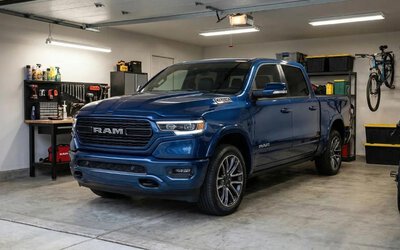
Your Ram can give you plenty of warning before an engine problem becomes a major repair.
A new ticking sound. Rough idle. A check-engine light. Slower acceleration. Excessive oil use. None of these symptoms automatically means your engine is finished. But ignoring them can turn a manageable problem into a much more expensive one.
That is why understanding Ram engine problems matters.
The Ram 1500 engine lineup has also changed significantly in recent years. The 2026 Ram 1500 offers the 5.7L HEMI V8 with eTorque alongside the 3.0L Hurricane engines and 3.6L Pentastar V6, depending on configuration.
This guide explains the symptoms owners commonly notice, what may be behind them, how to approach diagnosis, and what should make you stop driving and get professional help.
Key Facts at a Glance
- A ticking sound does not automatically mean internal engine failure.
- On HEMI engines, owners commonly discuss both exhaust-manifold problems and lifter/camshaft problems when describing ticking noises.
- A persistent misfire can be more important than the noise itself because it may point toward ignition, fuel, compression, or valvetrain problems.
- The 2026 Ram 1500 offers multiple gas-engine choices, so diagnosis depends heavily on the engine, model year, mileage, and symptoms.
- Routine oil service, correct fluids, cooling-system maintenance, and timely diagnosis remain the foundation of engine reliability.
- If an engine has low oil pressure, severe knocking, overheating, or a flashing check-engine light, continuing to drive can make the damage worse.
What Counts as a Ram Engine Problem?
A Ram engine problem is any mechanical, combustion, lubrication, cooling, or electronic issue that prevents the engine from operating as intended.
That sounds broad because it is.
An engine doesn’t have to fail completely to have a problem. A small vacuum leak, worn spark plug, faulty ignition coil, leaking exhaust manifold, or developing valvetrain issue can all affect how the truck runs.
The tricky part is that different problems can create similar symptoms.
A rough idle might be caused by a spark plug.
It might also be an ignition coil, injector, vacuum leak, low compression, or mechanical problem.
That is why replacing random parts based only on a dashboard code or internet post is rarely the smartest approach.
Common Ram Engine Problems and Symptoms
1. Engine Ticking or Knocking
This is one of the symptoms that gets the most attention from HEMI owners.
And there is an important distinction.
A ticking noise from an exhaust manifold or broken manifold hardware is not the same problem as a damaged lifter or camshaft.
Ram owners frequently discuss several different noises under the general label of “HEMI tick.” Some report ticking mainly during cold starts, while others describe a noise that continues after the engine warms up.
A persistent ticking noise should therefore be diagnosed rather than automatically labeled “HEMI tick.”
If the noise is accompanied by a misfire, rough running, loss of power, or check-engine light, the situation deserves more attention.
2. Rough Idle or Engine Shaking
A Ram that shakes at idle is telling you that combustion may not be happening evenly.
Possible causes include:
- Worn or fouled spark plugs
- Weak ignition coil
- Fuel injector problems
- Vacuum leaks
- Throttle-body issues
- Low compression
- Valvetrain problems
- Engine-control faults
A cylinder-specific diagnostic code can narrow the search.
For example, a misfire code can tell you which cylinder the computer believes is having trouble. It does not automatically tell you why that cylinder is misfiring.
That distinction can save a lot of wasted parts and money.
3. Check-Engine Light
A check-engine light is information, not a diagnosis.
A steady light generally means the vehicle has detected a fault that should be investigated. A flashing check-engine light is more urgent because an active misfire can damage the catalytic converter.
Do not simply clear the code and continue driving indefinitely.
Record the code first. Then investigate what caused it.
4. Loss of Power or Poor Acceleration
If your Ram suddenly feels weaker, think beyond the engine itself.
Possible causes include:
- Ignition problems
- Fuel-delivery problems
- Restricted airflow
- Turbocharger-related issues on applicable engines
- Sensor faults
- Exhaust restrictions
- Transmission problems
- Internal engine problems
This is another situation where a proper diagnostic scan combined with mechanical testing is more useful than guessing.
The HEMI Tick: What Ram Owners Should Understand
The phrase “HEMI tick” gets used so often that it has almost become a diagnosis by itself.
It isn’t.
Ram owners and forum members describe several different noises under that label. Some discussions point toward exhaust-manifold leaks or broken hardware, while others involve lifters and camshaft wear.
That difference matters because the repair path can be completely different.
Exhaust Noise vs. Internal Engine Noise
A useful starting point is the behavior of the noise.
A noise that is strongest during a cold start and changes significantly as the exhaust system heats up can have a different cause from a consistent valvetrain-related noise.
But sound alone is not enough for a reliable diagnosis.
A mechanic may use:
- A mechanic’s stethoscope
- Scan-tool data
- Misfire counters
- Compression testing
- Leak-down testing
- Oil-pressure testing
- Visual inspection
- Valvetrain inspection
That is why “it sounds like a HEMI tick” should be treated as a symptom description, not a final diagnosis.
Common Ram Engine Problems: Symptoms, Causes, and Urgency
| Symptom | Possible Causes | First Diagnostic Direction | Urgency |
|---|---|---|---|
| Ticking at cold start | Exhaust leak, manifold hardware, valvetrain noise | Locate sound and compare cold/warm behavior | Medium |
| Persistent ticking | Valvetrain, lifter/cam issue, exhaust leak | Scan for misfire and perform mechanical inspection | High |
| Rough idle | Spark, fuel, vacuum, compression | Scan codes and inspect ignition | Medium |
| Cylinder misfire | Plug, coil, injector, compression, valvetrain | Test components and compression | High |
| Low oil pressure | Oil level, sensor, pump, internal wear | Verify with mechanical gauge | High |
| Overheating | Coolant loss, thermostat, fan, radiator, water pump | Check cooling system immediately | Very High |
| Blue exhaust smoke | Oil entering combustion chamber | Check oil use and compression | High |
| White smoke after warm-up | Possible coolant entering combustion chamber | Cooling-system and compression tests | High |
| Poor acceleration | Ignition, fuel, airflow, turbo, exhaust, mechanical | Scan plus fuel, air, and mechanical checks | Medium–High |
| Flashing check-engine light | Active misfire | Reduce driving and diagnose promptly | Very High |
On mobile devices, hold and swipe the table horizontally to view the full comparison.
These are diagnostic starting points, not guaranteed diagnoses.
Why Mileage Alone Doesn’t Tell the Whole Story
Two Ram trucks with the same mileage can have completely different engine conditions.
One may have spent most of its life cruising on the highway with regular maintenance.
Another may have spent years towing heavy trailers, idling for long periods, operating in extreme heat, or missing maintenance intervals.
Usage matters. So does maintenance history.
Oil condition, correct oil specification, cooling-system health, air filtration, ignition maintenance, towing load, operating temperature, and previous repairs all influence how an engine ages.
This is why “How many miles does it have?” is only the beginning of the conversation.
How the 2026 Ram Engine Lineup Changes the Conversation
The modern Ram 1500 is no longer a one-engine story.
For 2026, the Ram 1500 engine choices include:
- 5.7L HEMI V8 eTorque: 395 horsepower and 410 lb-ft of torque
- 3.0L Hurricane: 420 horsepower and 469 lb-ft of torque
- 3.0L Hurricane High Output: 540 horsepower and 521 lb-ft of torque
- 3.6L Pentastar V6 eTorque: 305 horsepower and 269 lb-ft of torque
That means a general article about Ram engine problems cannot treat every Ram engine as identical.
5.7L HEMI vs. 3.0L Hurricane
| Category | 5.7L HEMI V8 | 3.0L Hurricane |
|---|---|---|
| Configuration | V8 | Twin-turbo inline-six |
| 2026 Maximum Power | 395 hp | 420 hp standard / 540 hp H/O |
| 2026 Maximum Torque | 410 lb-ft | 469 lb-ft standard / 521 lb-ft H/O |
| Forced Induction | No | Twin turbo |
| Diagnostic Focus | Ignition, exhaust, valvetrain, lubrication | Turbo/air system, ignition, sensors, lubrication |
| Diagnostic Approach | Scan plus mechanical testing | Scan plus air/fuel/boost/mechanical testing |
On mobile, swipe horizontally to see the complete table.
The Hurricane family was introduced to the Ram 1500 lineup for 2025, bringing a newer turbocharged engine architecture to the truck.
The 5.7L HEMI then returned for select 2026 Ram 1500 models, giving buyers another V8 option.
For more details, see our 2026 Ram 1500 engine lineup guide.
What Ram Owners Are Saying in Forums and Reddit
Owner communities are valuable because they reveal the symptoms people actually experience.
They also show why online diagnosis has limits.
For example, Reddit discussions include Ram 1500 owners reporting suspected lifter problems, ticking sounds, misfires, and questions about whether a particular noise is related to the valvetrain or another component.
RamForum discussions also contain examples of owners dealing with lifter and camshaft concerns alongside misfire symptoms.
That disagreement is important.
The internet can help you recognize a pattern, but it cannot inspect your engine.
Use owner forums to generate questions.
Use proper diagnostics to get answers.
A Better Way to Diagnose Ram Engine Problems
Step 1: Write Down Exactly What Changed
Don’t just say, “The engine sounds bad.”
Write down:
- When it happens
- Whether the engine is cold or warm
- Whether it happens at idle or acceleration
- Engine speed when it occurs
- Whether the noise changes with RPM
- Whether the check-engine light is on
- Any recent repairs
- When the oil was last changed
- Whether the truck recently towed or worked hard
Small details can completely change the diagnostic path.
Step 2: Check the Basics
Before assuming an internal engine failure, check the fundamentals.
Look at:
- Engine oil level
- Coolant level
- Visible leaks
- Battery condition
- Air-filter condition
- Loose electrical connections
- Obvious exhaust leaks
Do not open a hot cooling system.
And do not continue running an engine that is severely overheating.
Step 3: Scan the Truck
An OBD-II scan can reveal stored and pending diagnostic codes.
But remember:
A code identifies a system or condition. It doesn’t necessarily identify the failed part.
A P0302, for example, indicates a cylinder-2 misfire. It does not automatically mean the spark plug is defective.
Step 4: Confirm Before Replacing Parts
If the problem points toward a mechanical issue, compression or leak-down testing may be appropriate.
If oil pressure is suspected, verify pressure with a mechanical gauge rather than relying only on a dashboard reading or sensor.
If the noise appears to come from the valvetrain, further inspection may be required.
This is where diagnosis becomes much cheaper than guessing.
When a Ram Engine Problem Becomes Urgent
Some symptoms deserve immediate attention.
Stop Driving and Investigate Promptly If:
- The engine is overheating
- Oil pressure is dangerously low
- A severe knocking sound suddenly appears
- The check-engine light is flashing
- The engine loses significant power
- You see heavy smoke
- The engine is shaking violently
- You smell raw fuel
- You find metal particles in the oil
A small noise is one thing.
A small noise plus misfire, low oil pressure, or loss of power is a completely different situation.
Maintenance Still Matters More Than Internet Myths
There is no magic additive, shortcut, or forum trick that replaces maintenance.
Oil and filter service should follow the requirements for your specific engine and operating conditions.
Spark plugs matter on gasoline engines. Cooling-system maintenance matters. Air filtration matters. And catching a small problem early matters.
For example, a persistent misfire can start with something relatively simple such as a spark plug or coil. If the underlying problem is ignored, however, continued misfire can create additional problems.
For related maintenance information, check out our Ram 1500 spark plug guide.
If you’re dealing with electrical symptoms alongside engine issues, our Ram electrical problems guide can also help you work through the basics.
What This Means for Ram Owners Going Forward
The biggest lesson is simple:
Don’t diagnose the noise. Diagnose the cause.
The return of the 5.7L HEMI for select 2026 Ram 1500 models gives buyers another V8 option, while the Hurricane family represents a newer turbocharged direction for the truck.
But regardless of which engine sits under the hood, the fundamentals stay the same.
Pay attention to changes.
Check warning lights.
Keep up with maintenance.
And investigate unusual symptoms before they become normal.
If your Ram develops a tick, don’t panic.
If it develops a tick plus a misfire, loss of power, or other warning signs, don’t ignore it either.
That middle ground is where good engine diagnosis begins.
Related Ram Care Pro Guides
- Best RAM 1500 Accessories Guide
- Ram Electrical Problems Fix
- How to Change Spark Plugs in a Ram 1500
- 2026 Ram 1500 Engine Lineup Guide
- Dodge Ram Pickup Accessories Guide
- Ram 2500 Cummins Guide
Conclusion: The Noise Is Not the Diagnosis
Ram engine problems are easier to deal with when you stop treating every strange sound as an automatic engine failure.
The most important thing is pattern recognition followed by proper testing.
A ticking HEMI may involve an exhaust issue. It may involve the valvetrain. A rough idle may be a simple ignition problem, or it may point toward something more serious.
The mistake is assuming you already know the answer.
Listen to the truck. Scan it. Check the basics. Test the suspected system. And when the evidence points toward internal engine damage, deal with it before a smaller repair becomes an engine-sized bill.
That is the real solution to Ram engine problems: not guessing faster, but diagnosing smarter.
Featured Image Prompt
Prompt: Create a realistic editorial automotive image for a US audience showing a modern Ram 1500 truck with the hood open, detailed engine bay visible, subtle diagnostic tools and a mechanic inspecting the engine, with a clean professional garage background. Use a strong blue brand color theme, natural lighting, realistic metal and engine textures, premium automotive journalism style, high contrast, sharp details, no visible logos or copyrighted text. Add large, bold US-English overlay text: “RAM ENGINE PROBLEMS: KNOW THE WARNING SIGNS”. Make the text highly readable on desktop and mobile. Aspect ratio: 1200:630.
Amazon Disclosure: Some links on this website may be affiliate links. If you make a purchase through an affiliate link, we may earn a small commission at no additional cost to you.










0 Comments