
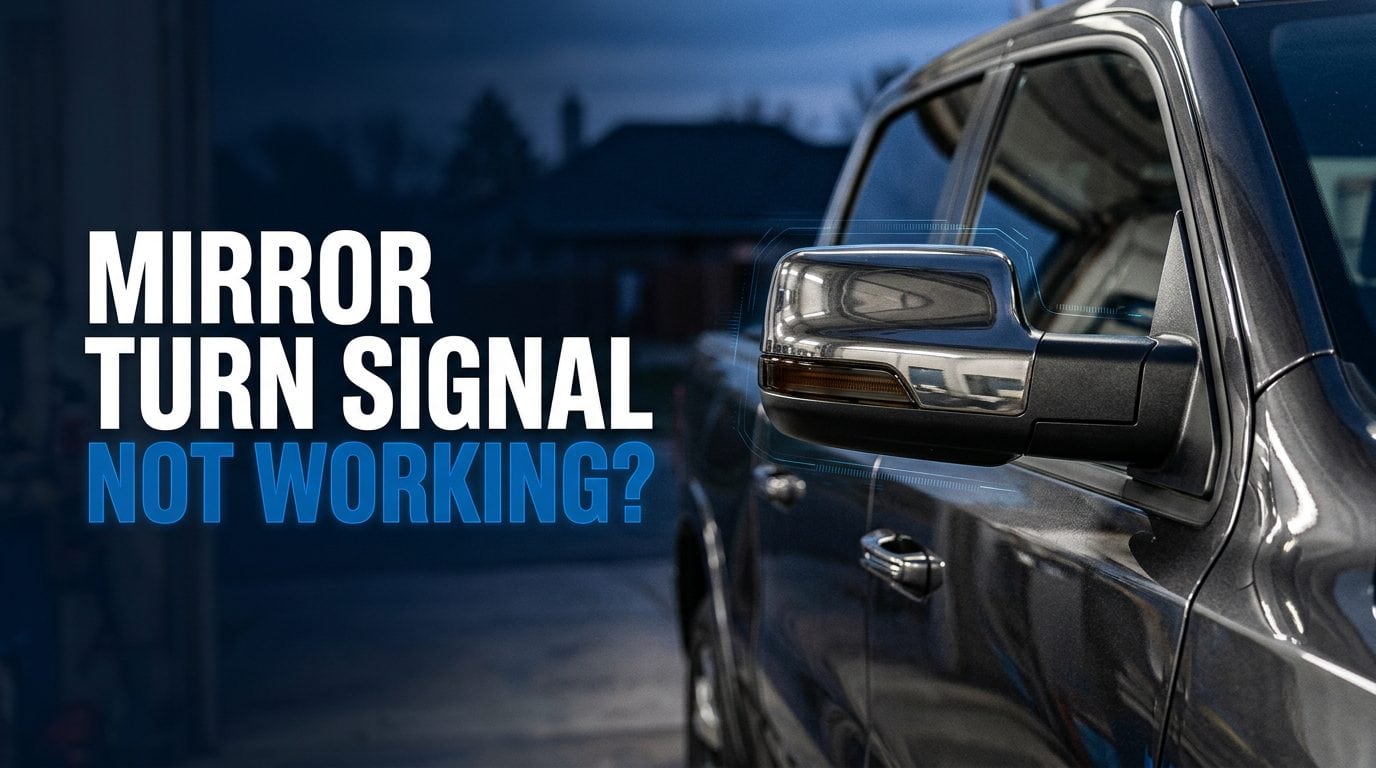
Learn how to test the hazards, separate an LED failure from a wiring issue, and avoid replacing the wrong mirror or fuse.
If your Ram 1500’s front and rear turn signals work but the light on one side mirror stays dark, it is easy to suspect a blown fuse. Sometimes a circuit problem is involved. But a failed LED module, a damaged connector, corrosion, an incompatible replacement mirror, or a broken wire can produce a similar symptom.
The fastest route to a sensible repair is to identify exactly what stopped working before buying parts. This guide explains what the mirror indicator does, what owners commonly report, and how to narrow the fault safely. Because Ram 1500 equipment changes by model year and trim, use the owner’s manual and wiring information for your specific truck—not a fuse number copied from another generation.
What Is the Ram 1500 Mirror Turn Signal?
The mirror turn signal is a small indicator built into or attached to the outside mirror. It repeats the vehicle’s turn signal where drivers beside or slightly behind the truck can see it. It works alongside the front and rear indicators; it does not replace them.
Ram’s 2023 owner’s manual describes equipped mirrors with LEDs in the lower outer corner. In that configuration, the signal LEDs flash with the corresponding front and rear lamps, and the hazard switch activates them too. The manual also distinguishes the turn-signal lighting from the approach or entry light. Other years and mirror options may use a different arrangement, so the exact equipment matters.
That distinction is useful when testing the truck. A small light that comes on when you unlock the doors may be an approach or puddle light, not proof that the turn-signal circuit works. Check the actual amber indicator while operating the turn signal and hazards.
Why the Problem Matters
A dead mirror indicator does not automatically mean every turn signal on the truck has failed, but it removes one visible signal from the vehicle. Other motorists may have fewer cues when you change lanes or turn, especially in traffic or poor weather. Check the front and rear lamps as well, and avoid driving if a required exterior turn signal is not functioning properly.
It also matters because the mirror may contain several separate features: power adjustment, heating, power folding, approach lighting, memory, blind-spot equipment, or a camera, depending on the truck. One feature can fail while the others continue working. A mirror that still adjusts electrically is not proof that its turn-signal LED or dedicated wiring is healthy.
Start With the Symptom: What Does It Tell You?
Before pulling a fuse or removing the door panel, observe the fault. Is it one mirror or both? Do the front and rear lamps flash at a normal rate? Did the problem begin after an impact, a mirror replacement, or installing aftermarket LEDs? Those details help narrow the likely cause.
| What You Notice | More Likely Areas to Check | What It Suggests | Best Next Step |
|---|---|---|---|
| One mirror signal is dark; front and rear signals work | LED module, local connector, corrosion, or wire to that mirror | The wider turn-signal system is at least partly operating | Inspect visible damage and connector history; test the mirror circuit before replacing parts |
| Both mirror signals are dark; front and rear signals work | Mirror fitment, shared connector or harness issue, configuration, or more than one failed LED | A single failed LED is less convincing as the only explanation | Confirm the mirrors are the correct factory or compatible replacements, then diagnose the shared circuit |
| Mirror signal flickers or flashes weakly | Loose connection, corrosion, damaged wiring, or a faulty replacement LED unit | An intermittent electrical connection or module may be involved | Record when it happens; ask for connector and voltage checks instead of guessing at a fuse |
| Front, rear, and mirror turn signals all fail on one side | Vehicle-side turn-signal circuit, relevant fuse or control module, wiring, or lamp faults | The issue may extend beyond the mirror assembly | Follow the model-year wiring diagram and owner-manual procedure; stop if the circuit needs electrical testing |
| Problem started after a mirror or LED replacement | Incorrect part, mismatched connector, incomplete seating, polarity or wiring differences | Fitment or installation deserves attention before other parts are replaced | Compare the replacement part number, connector, and feature list with the original setup |
On a phone, you can also swipe left or right directly on the table. The slider above moves the table horizontally.
How to Troubleshoot It Without Guessing
1. Test Both Turn Signals and the Hazards
Park safely, turn on the left signal, then the right, and check the front, rear, and mirror lamps. Next, switch on the hazard flashers. Have another person watch from outside if needed; do not stand in traffic to inspect the lights.
If the front and rear lamps on the same side flash normally but the mirror indicator remains dark, do not start by assuming the truck’s entire turn-signal circuit is dead. The fault may be local to the mirror. If multiple lamps fail, expand the diagnosis to the vehicle-side circuit.
2. Look Closely at the Mirror
Check for a cracked lens, impact marks, moisture, a loose housing, or visible damage around the signal lens. If the mirror was recently hit, folded forcefully, or replaced, make a note of that. Water intrusion and corrosion are plausible causes of intermittent lighting, but visual inspection alone cannot confirm the electrical fault.
Do not pry off mirror glass just to look for a bulb unless you have the procedure for your exact assembly. Mirror glass and hidden clips can break during removal. Some versions let you replace the LED signal module separately; other designs and replacement options differ.
3. Verify the Mirror Is Equipped and Compatible
This check is especially important when the truck has aftermarket tow mirrors or a previous owner changed the assembly. Two mirrors can look almost identical yet have different connectors or feature sets. Power adjustment, heating, folding, puddle lights, blind-spot monitoring, cameras, and turn signals are not guaranteed to be included in every replacement.
Compare the truck’s model year, trim, original mirror options, connector, and part number with the installed unit. A mirror can physically fit while one feature remains unconnected or incompatible. For broader configuration background, see our Ram 1500 mirrors guide.
4. Check the Fuse Only With the Correct Diagram
A fuse is worth checking when symptoms point to a wider electrical fault, but do not rely on an online fuse number from a different year. Fuse-panel locations, labels, and circuit architecture can change by generation and equipment. The words “mirror” in a fuse list may also refer to another mirror-related function rather than the outside turn-signal LEDs.
Use the owner’s manual for your exact model year and match the fuse description to the correct panel. Switch the vehicle off and follow the manual’s safety instructions. Replace a fuse only with the specified rating. Never install a higher-amp fuse to prevent it from blowing. If a replacement fuse fails again, stop and have the circuit tested.
For a focused explanation of fuse-panel labels and why year-specific diagrams matter, read our Ram 1500 mirror reference and check the truck’s own manual before acting.
5. Have the Connector and Wiring Tested
If the lamp remains dark, the next useful step is an electrical test—not replacing unrelated parts. A technician can use the correct wiring diagram and a multimeter to check for the expected power and ground at the mirror connector while the signal is commanded on. The result helps separate a failed LED module from a wiring, connector, or vehicle-side control issue.
Do not put battery voltage onto unknown connector pins or probe wiring around driver-assistance equipment without the proper service information. That can damage electronics or create a safety problem. If several functions in the same door stopped working at once, tell the technician; a shared supply, connector, harness, or door module may deserve attention.
What Ram Owners Say in Forums and on Reddit
Owner discussions are useful for spotting recurring questions, but they are not a substitute for a wiring diagram. In a RamForum thread about a 2014 Ram 1500 with tow mirrors, members described failed LED turn signals and corrosion as possible issues; one owner reported replacing signal modules and restoring operation. The practical lesson is that the LED part may be serviceable separately on some assemblies, not that every Ram uses the same repair.
Another RamForum discussion describes replacement LED signals that worked intermittently or flashed weakly. That matches a symptom pattern worth investigating, but it does not prove the replacement parts were defective in every case. Connector fit, wiring, the installed unit, and the vehicle’s setup still need checking.
In a Reddit thread, an owner said both mirror indicators were out despite the mirrors being powered, while other commenters raised possibilities ranging from wiring and connections to a failed LED unit. Those suggestions were guesses from fellow owners, not a verified diagnosis. In particular, do not copy a fuse number from a comment unless it matches the diagram for your exact truck.
The useful consensus is simple: working mirror adjustment does not guarantee a working indicator, and an LED failure does not always mean the entire mirror must be replaced. Confirm the specific assembly and test the circuit before buying parts.
How Mirror Designs and Model Years Compare
Older and newer Ram 1500 mirrors can differ in the signal module, connector, lighting package, and integrated electronics. Some older tow-mirror configurations allow a separate signal lamp replacement. Some newer equipped mirrors use LED side indicators listed as LED in the owner’s manual. That does not mean the repair procedure is interchangeable.
Before removing the mirror glass or ordering a part, identify the model year and option package. For context on how equipment and generation can vary, you can also read our guides to Ram 1500 model years, daily-driver equipment, and Ram 1500 accessories.
When to Stop DIY Troubleshooting
Basic visual checks and a hazard-light test are sensible first steps. Stop if the job requires removing fragile mirror glass and you do not have the service procedure, if wiring insulation is damaged, if a fuse repeatedly blows, or if the truck has a warning or failure affecting more than the mirror indicator.
Bring the technician three specific facts: which side is affected, whether the front and rear lamps work normally, and whether the problem began after a repair or mirror replacement. Those details help narrow the test plan and reduce trial-and-error parts swapping. You can browse the RAM Care Pro maintenance and repair guides for related truck-owner context, but use model-specific service information for electrical work.
Conclusion: Diagnose the Signal, Not the Guess
When a Ram 1500 mirror turn signal stops working, start with the pattern: one mirror or both, mirror-only or all turn lamps, steady failure or intermittent flashing. Test the hazards, inspect obvious damage, confirm the mirror’s feature compatibility, and use the correct year-specific wiring information before touching fuses or wiring.
The main takeaway: do not replace the whole mirror just because its signal is dark, and do not assume a fuse is the answer because the symptom is electrical. Find out whether the failure is in the LED module, connector, wiring, or vehicle circuit first. That is the most reliable way to get the correct repair without paying for parts you may not need.
Sources and Further Reading
- 2023 Ram 1500 Owner’s Manual (Mopar) — mirror turn-signal and approach-lighting description; exterior side indicators listed as LED where equipped.
- 2024 Ram 1500 Owner’s Manual (Mopar) — confirms equipped mirrors use LED turn indicators and that features vary by equipment.
- RamForum: Mirror Turn Signal Not Working — owner reports about LED signal failure, corrosion, and separate lamp replacement on one tow-mirror configuration.
- RamForum: Mirror Turn Signals — a discussion of intermittent replacement LED signals.
- Reddit: Mirror turn signals not working — owner question about both mirror indicators failing while powered mirror functions remain available.
Note: Forum and Reddit posts describe individual experiences, not confirmed diagnoses for every model year. Always verify the instructions and electrical diagram for your own truck.









0 Comments