
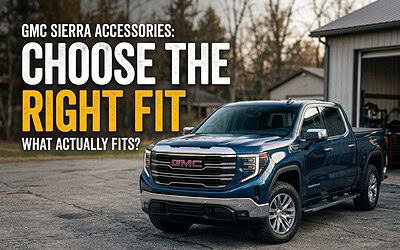
GMC trucks already offer a lot straight from the factory, but many owners still want to make them more useful, comfortable, or personal. That’s where GMC aftermarket accessories come in. From running boards and bed covers to suspension upgrades and auxiliary lighting, these additions can change how a truck looks and works.
However, not every accessory fits every GMC. A part designed for one Sierra generation may not work with another, and an upgrade that looks simple can affect ride quality, towing, visibility, or vehicle electronics.
Understanding these trade-offs matters in 2026, when trucks rely on increasingly complex electrical systems, driver-assistance technology, and model-specific equipment. This guide explains what GMC aftermarket accessories are, how they differ from factory accessories, and what owners should understand before modifying their vehicles.
What Are GMC Aftermarket Accessories?
GMC aftermarket accessories are products made by independent manufacturers for use on GMC vehicles. They can add features that were not included from the factory, replace original equipment, or change an existing feature.
For example, a Sierra 1500 owner might add a tonneau cover to protect cargo, install running boards to make the cab easier to reach, or change the suspension to suit a particular type of off-road driving.
The term covers much more than appearance upgrades. Some accessories solve everyday problems, while others change how a vehicle performs or carries equipment.
Common types of GMC aftermarket accessories
- Exterior accessories: Grilles, hood protectors, fender flares, and trim pieces.
- Bed and cargo accessories: Tonneau covers, bed liners, toolboxes, racks, and dividers.
- Interior accessories: Floor liners, seat covers, organizers, and cargo protection.
- Access accessories: Running boards, side steps, and grab handles.
- Lighting and electronics: Auxiliary lights, dash cameras, audio equipment, and charging accessories.
- Performance and suspension parts: Shocks, leveling kits, lift kits, intake systems, and exhaust components.
- Towing equipment: Compatible hitch accessories, mirrors, and trailer-related equipment.
A useful distinction is that an aftermarket accessory is not automatically a performance upgrade. A floor liner can improve interior protection without changing vehicle performance, while a suspension modification can affect several aspects of how the truck drives.
Why GMC Aftermarket Accessories Matter in 2026
Truck owners increasingly use one vehicle for several jobs. A GMC Sierra might serve as a daily commuter during the week, tow a trailer on weekends, and carry tools or outdoor equipment when needed.
That makes practical customization appealing. A bed cover can keep cargo less exposed to weather. Running boards can make entry easier. Properly selected storage equipment can help keep tools organized instead of sliding around the bed.
The important question is not simply whether an accessory looks good. It is whether it solves a real problem without introducing a new one.
Modern trucks require more careful compatibility checks
Older vehicles often had fewer electronic systems to consider when adding basic equipment. Modern GMC models may include cameras, parking sensors, advanced driver-assistance features, complex infotainment systems, and electronically controlled vehicle functions.
An accessory that interferes with a camera’s field of view, blocks a sensor, or is wired incorrectly can create problems beyond appearance.
For example, auxiliary lighting needs appropriate mounting and wiring. A grille replacement must account for any sensors or cameras in that area. Suspension changes may require additional checks to confirm that steering, alignment, and relevant driver-assistance systems operate correctly.
The lesson is straightforward: compatibility means more than whether a part can physically be bolted onto the truck.
GMC Aftermarket Accessories: OEM vs. Aftermarket vs. Universal
These three categories often overlap in the wider accessory market, but they are not identical.
| Feature | OEM or genuine GMC accessory | Vehicle-specific aftermarket | Universal accessory |
|---|---|---|---|
| Intended fit | Listed GMC models and configurations | Listed makes, models, and years | Broad range of vehicles |
| Installation | May use factory mounting points | Depends on the design and vehicle | May need adapters or modifications |
| Product development | Developed or approved for specific applications, depending on the item | Developed by an independent manufacturer | Designed for general use |
| Warranty | Subject to applicable GMC accessory terms | Manufacturer’s own terms usually apply | Manufacturer’s own terms usually apply |
| Main consideration | Confirm the exact application | Check detailed fitment and installation requirements | Confirm dimensions, mounting, and safe operation |
| Comparison point | OEM GMC | Vehicle-specific aftermarket | Universal |
|---|---|---|---|
| Fitment certainty | High when application is confirmed | High when exact specifications match | Varies with measurements and installation |
| Customization range | Depends on factory catalog | Often broad | Broad but less tailored |
| Installation effort | Depends on accessory | Depends on design and instructions | May need additional fitting |
| Warranty responsibility | Applicable GMC accessory terms | Accessory manufacturer and applicable vehicle warranty rules | Accessory manufacturer and applicable vehicle warranty rules |
Mobile table tip: On a phone, swipe horizontally across the table to read all columns. The horizontal scrollbar below the table can also be dragged where supported.
There is no universal winner. A vehicle-specific aftermarket part may provide more customization options, while a genuine GMC accessory may offer a clearer path for checking vehicle application and accessory warranty terms. Universal equipment can work well for suitable applications, but it requires extra attention to dimensions and mounting.
What GMC Owners Are Saying About Aftermarket Modifications
Owner discussions on Reddit provide a useful look at the decisions people face after buying a truck.
In a GMC Sierra discussion about aftermarket support, one owner described weighing appearance, comfort, off-road capability, lighting, storage, and suspension changes. The discussion illustrates how customization often starts with a practical goal but expands as owners consider additional modifications.
Another Sierra owner discussion about suspension upgrades raises questions about ride quality, leveling kits, upper control arms, and warranty concerns.
A separate discussion about lifting or keeping a truck at stock height shows that owners can disagree about whether a modified stance is worth the trade-offs.
These conversations are anecdotal, not controlled tests. Still, they highlight three recurring themes:
- Fitment matters: Wheel offset, tire size, suspension design, and trim can affect whether parts work together.
- Every modification has trade-offs: Bigger tires or a lift may change ride behavior, fuel use, or component loads.
- Real-world use should guide decisions: A work truck, daily driver, and dedicated off-road vehicle do not necessarily need the same equipment.
The best lesson from owner forums is to use other people’s experiences as starting points for research, not as substitutes for manufacturer instructions or professional inspection.
How Accessories Can Affect Safety and Vehicle Performance
Some accessories have very little effect on vehicle operation. Others can change important mechanical or electrical characteristics.
Wheels, tires, and suspension
Larger tires and suspension lifts can change ground clearance, handling, steering geometry, and the relationship between the tires and bodywork. Heavier wheels and tires can also increase unsprung mass, which may affect ride and suspension response.
Depending on the specific modification, owners may need to consider tire clearance, alignment, brake performance, speedometer accuracy, and whether the new setup remains within the vehicle’s load and towing limits.
A lift kit does not automatically increase the truck’s rated payload or towing capacity. Those limits depend on the vehicle’s specifications, configuration, and applicable ratings.
Lighting and electronic accessories
Auxiliary lights should be mounted securely, aimed correctly, and wired with suitable protection. Their use on public roads must comply with applicable laws.
Other electronic additions can create issues if they draw power continuously, interfere with factory wiring, or are installed without proper circuit protection. Poorly installed equipment can contribute to electrical faults or battery drain.
For accessories involving airbags, steering, brakes, sensors, or other safety-critical systems, use a qualified professional and follow the vehicle and accessory manufacturers’ instructions.
GMC Aftermarket Accessories and Warranty Coverage
Warranty concerns are common among truck owners, and the details matter.
GMC explains that vehicle warranty coverage can be affected when a modification causes damage to covered components. That is different from saying that every aftermarket accessory automatically cancels the entire vehicle warranty.
According to GMC’s official warranty and protection information, the applicable coverage depends on the warranty terms and circumstances. GMC also distinguishes genuine GMC accessories from products supplied by independent accessory manufacturers.
In practical terms, keep three things in mind:
- A modification does not automatically erase every warranty right. The relevant warranty terms and the relationship between the modification and the problem matter.
- Damage caused by an accessory may not be covered as a factory defect. For example, an electrical problem caused by improper aftermarket wiring can be treated differently from an unrelated manufacturing defect.
- Accessory warranties are not all the same. Coverage can vary by product, seller, installer, and whether the accessory is a genuine GMC item or an independent product.
Before changing a newer truck, review the warranty booklet and ask the dealer or manufacturer how the specific modification may affect relevant coverage. Keep receipts, installation records, product specifications, and alignment reports where applicable.
A Practical Checklist Before Modifying Your GMC
Before installing GMC aftermarket accessories, check these details:
- Model year: Confirm the part is listed for your exact year and generation.
- Model and trim: Sierra 1500, Sierra HD, and Canyon applications can differ substantially.
- Cab and bed configuration: Crew cab, double cab, bed length, and body style may affect fitment.
- Factory equipment: Check for cameras, sensors, special bumpers, power steps, or other features that may conflict with the accessory.
- Load and towing limits: Do not assume a modification increases factory ratings.
- Installation requirements: Identify whether the job involves drilling, cutting, electrical work, calibration, or special tools.
- Warranty terms: Understand who covers the accessory and what happens if an installation-related problem occurs.
- Local regulations: Check applicable rules for lighting, window tint, emissions-related modifications, tire coverage, and vehicle height.
A listing that says “fits GMC Sierra” is not detailed enough on its own. Ask for the specific model-year and configuration information.
What GMC Aftermarket Accessories Mean for Owners Going Forward
The aftermarket gives GMC owners more ways to adapt a truck to work, family life, recreation, and personal style. That flexibility is valuable, but it also places more responsibility on the owner to understand how components work together.
As vehicles add more electronics and driver-assistance features, compatibility and installation quality will matter just as much as the accessory itself. This is especially true for suspension, lighting, wheels and tires, and equipment that interacts with factory electrical systems.
Owners can also benefit from thinking about their trucks as complete systems rather than collections of separate parts. A new bumper may affect sensors. A lift may change tire clearance. A bed rack may affect how a cover opens or how cargo is secured.
Planning changes together can help prevent unnecessary expense and avoid combinations that do not work as intended.
Key Facts at a Glance
- GMC aftermarket accessories can improve utility, protection, comfort, appearance, or off-road capability.
- OEM, vehicle-specific aftermarket, and universal accessories differ in fitment and warranty arrangements.
- Exact model year, trim, cab, bed, and factory equipment can determine compatibility.
- Lifts, wheels, tires, lighting, and electronic accessories can introduce safety or performance considerations.
- A modification does not automatically cancel an entire vehicle warranty, but modification-related damage may not be covered.
- GMC owner forums can provide useful experience, but manufacturer specifications and professional guidance should determine safety-critical decisions.
- The most useful accessory is one that solves a real problem without creating a larger one.
Conclusion: Fitment Matters More Than Hype
GMC aftermarket accessories can make a Sierra or Canyon more practical, more comfortable, or better suited to a particular job. But adding equipment simply because it looks impressive is not always the smartest approach.
Start with the job you need the truck to do, verify compatibility, and understand the safety and warranty implications before installation. That approach is more valuable than chasing the biggest tires, tallest lift, or most aggressive appearance. A well-matched modification should improve the ownership experience without compromising what made the truck useful in the first place.






0 Comments