RAM Truck Parts: How to Choose the Right Part Without Guessing
2026 Guide to OEM, aftermarket, used, and replacement RAM truck parts—and the fitment details that can save you time, money, and frustration.
If you own a RAM truck long enough, you eventually need a part.
Maybe it is something simple, like a brake pad, air filter, mirror, or floor liner. Or maybe it is something more serious, such as a suspension component, electrical module, cooling-system part, or engine component.
That is where things can get surprisingly complicated.
Searching for RAM truck parts can bring up hundreds of choices. Some are OEM. Some are aftermarket. Some are used. Some look almost identical but fit only a specific year, engine, trim, cab, or bed configuration.
And that is the part many owners discover the hard way: the cheapest-looking part is not always the simplest solution.
In 2026, this matters even more because newer RAM trucks have more electronics, more configuration differences, and more factory-integrated systems.
So this guide is not about telling you what product to buy. It is about understanding the RAM parts landscape so you can make a better decision before ordering anything.
Key Facts at a Glance
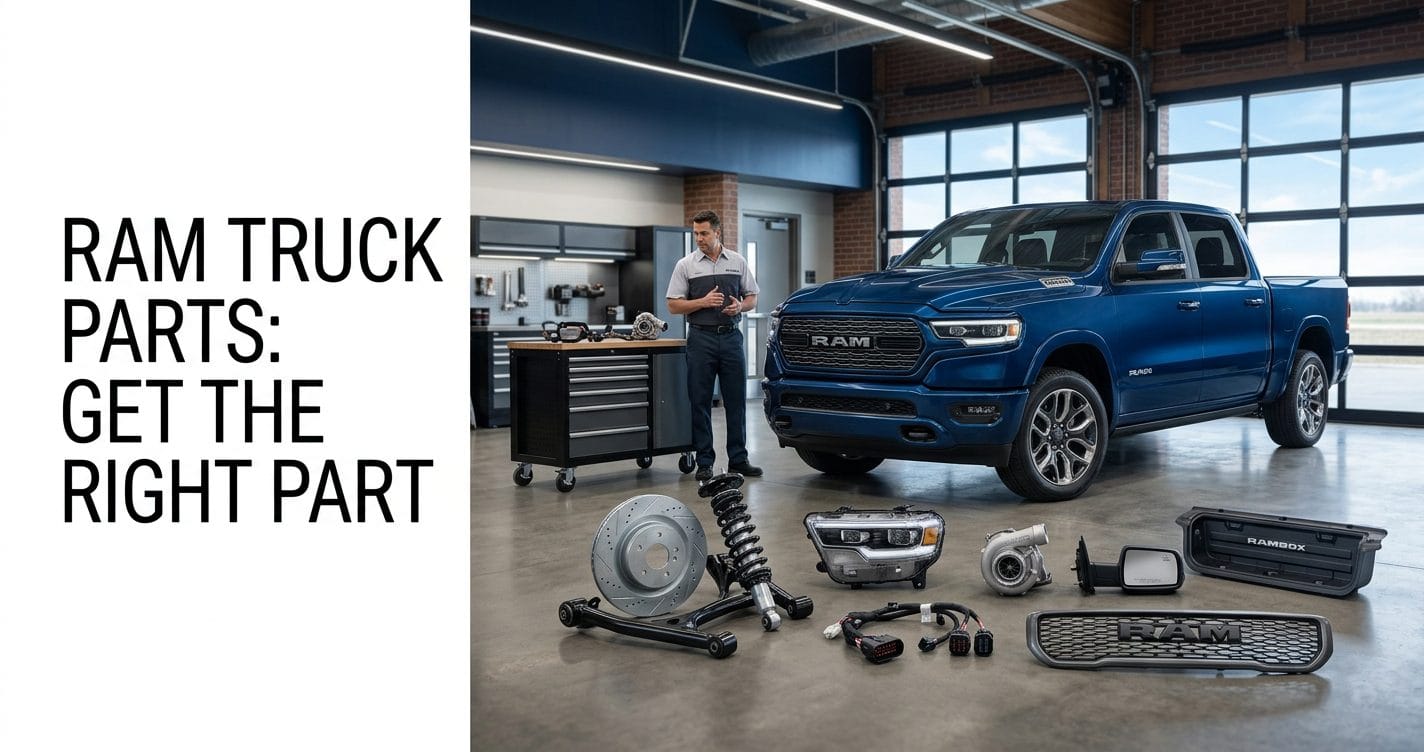
- RAM truck parts include mechanical, electrical, body, interior, suspension, braking, and accessory components.
- OEM parts are designed around the original vehicle specifications, while aftermarket parts can vary significantly in design and quality.
- Year, trim, engine, drivetrain, cab, bed length, and factory options can affect fitment.
- Older RAM trucks may have fewer original parts available, making quality aftermarket or used components more important.
- Modern RAM trucks contain more electronic systems, so wiring and compatibility deserve extra attention.
- A correct part number or VIN-based fitment check can be more valuable than simply searching by vehicle name.
What Are RAM Truck Parts?
The phrase “RAM truck parts” sounds simple, but it covers a huge range of components.
It includes everything from routine maintenance parts to major mechanical assemblies.
RAM 1500, RAM 2500, and RAM 3500 trucks may look related, but their parts requirements can be very different. Even two RAM 1500 trucks can use different components depending on model year, engine, trim, drivetrain, body configuration, and factory equipment.
That is why identifying the exact truck matters before identifying the part.
The Main RAM Truck Parts Categories
- Engine parts: filters, spark plugs, sensors, belts, gaskets, cooling components, and internal engine parts.
- Brake parts: pads, rotors, calipers, lines, ABS components, and related hardware.
- Suspension and steering: shocks, control arms, ball joints, tie rods, bushings, steering components, and related hardware.
- Electrical parts: batteries, switches, sensors, modules, wiring, lighting, starters, alternators, and power-distribution components.
- Body parts: bumpers, grilles, mirrors, doors, fenders, tailgates, trim, and exterior hardware.
- Interior parts: seats, console pieces, switches, floor components, trim, and convenience equipment.
- Truck accessories: bed protection, cargo management, running boards, towing equipment, floor liners, storage, and exterior accessories.
Why RAM Parts Have Become More Complicated
Older trucks were often easier to understand from a parts perspective.
You could identify the truck, find the engine, locate the component, and move on.
Modern trucks are different.
The 2026 RAM 1500 is available with several engine choices, including the 3.6-liter Pentastar V6, 3.0-liter Hurricane engines, and the returning 5.7-liter HEMI V8.
That creates more combinations for parts catalogs to account for.
And the engine is only one piece of the puzzle.
A bumper might depend on parking sensors. A mirror can depend on power-folding equipment or other factory features. A lighting component may interact with the vehicle’s electrical system.
This is why “Will this fit my RAM?” is often a better question than “Is this a RAM part?”
OEM vs. Aftermarket vs. Used RAM Truck Parts
This is probably the biggest decision owners face.
But it is not as simple as saying one category is always better.
OEM RAM Parts
OEM means the component is made to the vehicle manufacturer’s specifications.
For RAM vehicles, genuine Mopar parts are the factory-branded option.
The major advantage is predictable fitment and compatibility when the correct application is selected.
That can be especially important for parts that interact with electronics, sensors, mounting points, or other factory systems.
Aftermarket RAM Parts
Aftermarket parts are made by companies other than the vehicle manufacturer.
Quality varies.
That is the important part.
A good aftermarket component can be a perfectly sensible solution. A poorly designed one can create fitment problems, premature wear, noise, leaks, electrical issues, or extra installation work.
Recent RAM owner discussions show exactly this split. Some owners report using aftermarket components successfully, while others emphasize researching the manufacturer and checking the exact part number before ordering.
Used RAM Parts
Used RAM parts can make sense when a component is expensive, discontinued, cosmetic, or difficult to locate.
They are especially relevant for older trucks.
But condition matters.
A used body panel is not the same risk as a used electronic module. A used grille may be easy to inspect visually, while an electrical component can be much harder to evaluate before installation.
RAM Truck Parts: OEM vs. Aftermarket vs. Used
The following table gives you a practical way to think about the three categories.
| Factor | OEM | Aftermarket | Used |
|---|---|---|---|
| Fitment predictability | High when correctly matched | Varies by manufacturer | Depends on donor vehicle |
| Vehicle-specific design | Yes | Sometimes | Yes, if correct donor |
| Price | Usually higher | Low to high | Often lower |
| Condition uncertainty | Low | Depends on brand | Higher |
| Older truck availability | Can decline | Often better | Can be excellent |
| Electronics compatibility | Generally predictable | Must be researched | Must verify carefully |
| Best use case | Exact replacement | Repair or upgrade with verified fitment | Older, discontinued, or cosmetic parts |
| Main concern | Cost | Quality variation | Condition/history |
On mobile? Swipe the table horizontally to see the full comparison.
Why Part Numbers Matter So Much
Here is one of the easiest ways to avoid a bad parts order:
Do not rely only on the words “RAM 1500.”
Use the actual part number whenever possible.
RAM trucks can have several versions of what appears to be the same component.
A bumper is a good example.
One owner discussion described finding multiple part numbers for what appeared to be the same bumper. The differences included finish, exhaust configuration, and parking-assist sensors.
That is a perfect example of why visual similarity does not guarantee compatibility.
The same principle applies to:
- Mirrors
- Headlights
- Tail lights
- Bumpers
- Grilles
- Suspension components
- Sensors
- Electrical modules
- Wiring
- Interior trim
If you have access to the VIN, use it when checking compatibility.
If you already have the old component, compare its part number where possible.
Five minutes of verification can prevent hours of installation frustration.
Older RAM Trucks Have a Different Parts Problem
Parts availability changes as trucks age.
This is especially noticeable with older generations.
A RAM owner trying to rebuild suspension on an older truck may discover that some factory components are discontinued or difficult to locate. Owner discussions show that aftermarket parts can become the practical solution when original components are no longer available.
That does not automatically make aftermarket parts bad.
It simply changes the research process.
For an older RAM, you may need to compare:
- Original part availability.
- Aftermarket replacements.
- Used components.
- Updated or superseded part numbers.
- Compatibility with the exact generation.
This is where experienced owners and repair communities can be useful.
A parts catalog tells you what should fit.
Owners can sometimes tell you what actually worked.
What RAM Owners Are Saying
Recent Reddit and RAM owner discussions reveal a consistent pattern.
Owners rarely disagree about whether parts matter. They disagree about which source makes the most sense for a particular job.
Some prefer OEM for critical repairs and factory-specific components. Others use aftermarket parts successfully for suspension, maintenance, appearance, and performance work.
One recurring piece of advice is surprisingly simple: research the part number and manufacturer before buying.
Another common issue is availability.
An owner may find an OEM component but discover that it is expensive or backordered. Another owner may find an aftermarket alternative immediately.
That is why there is no universal “best” RAM parts source.
The right answer depends on the part.
Modern RAM Trucks Add Another Layer: Electronics
This is one area where newer trucks deserve extra caution.
The current RAM parts catalog includes a large range of electrical components, including sensors, modules, switches, wiring, lighting, power-distribution components, and vehicle-control equipment.
That means an electronic part is not necessarily a simple plug-and-play decision.
An incorrectly selected or poorly integrated electrical component can create problems that are much harder to diagnose than a bad floor mat or cosmetic trim piece.
For powered accessories and electrical repairs, pay attention to:
- Correct voltage and connections.
- Factory connectors.
- Fuse requirements.
- Grounding.
- Battery draw.
- Sensor compatibility.
- Whether programming or calibration is required.
- Whether the part is designed for your exact model year.
More technology makes RAM trucks more capable, but it also makes compatibility more important.
How RAM Truck Parts Compare With the Past
The biggest change is not that RAM suddenly has more parts.
It is that more parts are connected to other systems.
A mechanical component can often be evaluated by dimensions, materials, and physical fit.
A modern electronic component may need to communicate with other vehicle systems.
That changes the definition of “fits.”
There are now at least three questions:
- Will it physically fit?
- Will it work correctly?
- Will it work correctly with the rest of the truck?
That third question is the one worth remembering.
Where Accessories Fit Into the Bigger Picture
Not every RAM part is a repair part.
Accessories are also part of the larger RAM truck ecosystem.
A bed mat, tonneau cover, running board, cargo organizer, floor liner, towing accessory, or exterior protection product can change how you use the truck without changing its core mechanical system.
If your RAM is a daily driver, our guide to Dodge Ram 1500 daily driver accessories covers practical upgrades designed around everyday truck use.
For owners exploring the wider accessory category, see our guide to the best RAM 1500 accessories for more context on comfort, protection, cargo, appearance, and capability.
If you are researching pickup-specific upgrades, our Dodge Ram pickup accessories guide looks at how practical accessories are changing the way owners use their trucks.
Bed protection is another area where parts and accessories can overlap. Our RAM 1500 bed cover guide explains why the right bed solution depends heavily on how the truck is actually used.
For heavy-duty owners, our guide to Dodge Ram 2500 Cummins diesel accessories provides additional context for owners dealing with a different class of truck and workload.
You can also explore the broader Dodge Ram truck accessories and maintenance guides here at RAM Care Pro.
What This Means for RAM Owners Going Forward
The parts market is unlikely to become simpler.
Newer RAM trucks are becoming more electronically integrated, while older trucks are moving further into the aftermarket and used-parts world.
That creates two very different challenges.
Newer RAM owners need to pay closer attention to compatibility and electronic integration.
Older RAM owners may need to become better at finding alternatives when original parts disappear.
Both groups benefit from the same habit:
Identify first. Buy second.
Start with the truck’s exact year and configuration.
Then identify the component.
Find the original part number if possible.
Compare OEM, aftermarket, and used options.
Finally, check whether there are special requirements such as programming, sensors, wiring, calibration, or installation hardware.
That process is much safer than searching for “RAM truck parts” and choosing the first result that looks right.
A Simple RAM Parts Checklist
Before ordering any RAM truck part, check these details:
- Model year
- RAM model
- Engine
- 2WD or 4WD
- Cab configuration
- Bed length
- Trim level
- Factory options
- VIN compatibility
- Original part number
- Manufacturer
- Warranty
- Return policy
- Installation requirements
For electrical or computer-related components, add one more question:
Does this part require programming, calibration, or special setup?
That single question can save a lot of frustration.
The Bigger Lesson About RAM Truck Parts
The RAM parts market can look overwhelming because there are so many choices.
But the real problem is not the number of choices.
It is identification.
Once you know exactly what your truck has and exactly what needs to be replaced or changed, the choices become much easier to understand.
That is especially important in 2026, when RAM trucks combine traditional mechanical systems with increasingly sophisticated electronics.
The smartest approach is not automatically “buy OEM.”
It is not automatically “buy aftermarket.”
And it is definitely not “buy the cheapest one.”
The smartest approach is to choose the right part for the exact truck, from a source and manufacturer you can verify.
That is what actually matters.
Conclusion: Fitment Beats Guesswork
RAM truck parts are not complicated because there are too few options.
They are complicated because there are so many variations.
The difference between a successful repair and a frustrating one can be a single suffix on a part number, a missing sensor connection, a different trim level, or a model-year change.
So before you order, slow down.
Check the VIN. Check the part number. Check the configuration. Check what other RAM owners have experienced.
In 2026, accurate fitment is more valuable than a flashy parts list.
Get that part right, and everything else becomes much easier.






0 Comments