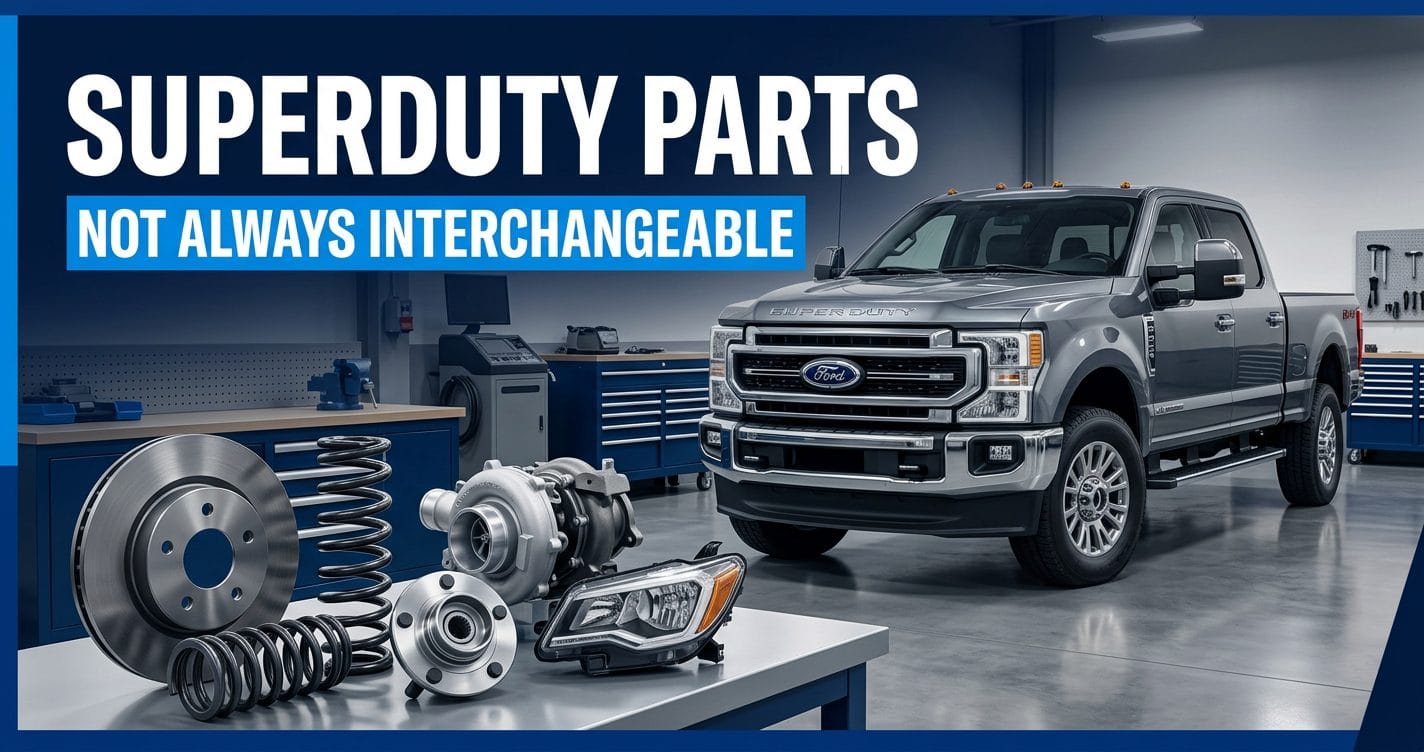
When you search for superduty parts, you might be looking for replacement brake components, suspension hardware, engine parts, lighting, or something as simple as a mirror. But finding a part labeled “Ford Super Duty” does not automatically mean it will fit your truck.
Ford’s Super Duty family includes heavy-duty pickups such as the F-250 and F-350, along with larger commercial models. These trucks can share many components, but differences in model year, engine, axle, drivetrain, cab configuration, and trim can change what fits.
In this guide, we’ll explain what Super Duty parts are, how original and aftermarket components differ, what truck owners discuss in online communities, and how to understand compatibility before a repair. Even if you’re more familiar with Ram trucks, the same basic lesson applies: the right part is the one engineered for your exact vehicle, not simply one carrying the right name.
1. What Are Superduty Parts?
Superduty parts are components designed for Ford’s Super Duty trucks, including the F-250 and F-350. Depending on the vehicle and application, the term can also cover parts for the F-450, F-550, and certain Super Duty commercial vehicles.
These parts serve different purposes. Some keep the truck running, while others support towing, hauling, safety, comfort, and appearance.
Common categories include:
- Engine and fuel system: Filters, belts, sensors, injectors, cooling components, and other engine-related parts.
- Transmission and drivetrain: Transmission components, driveshafts, transfer-case parts, axle components, and differential hardware.
- Suspension and steering: Shocks, springs, ball joints, steering links, bushings, and related hardware.
- Braking system: Pads, rotors, calipers, brake hoses, and associated components.
- Exterior and lighting: Mirrors, bumpers, grilles, headlights, tail lights, and body panels.
- Interior and electrical: Switches, seats, wiring components, instrument panels, and cabin accessories.
The important distinction is that Super Duty is a vehicle family, not a universal fitment specification.
A suspension component for one F-350 might not be suitable for another F-350 with a different axle or suspension configuration. Likewise, an exterior accessory can depend on the truck’s generation and trim.
2. Why Superduty Parts Matter in 2026
Heavy-duty trucks often work harder than ordinary passenger vehicles. Many spend their days towing equipment, carrying construction materials, pulling trailers, or covering long highway distances.
That workload makes parts condition and compatibility especially important.
A worn steering joint, damaged brake component, leaking coolant hose, or failing wheel bearing can affect more than comfort. Depending on the fault, it may compromise safe handling, reliability, or the truck’s ability to complete a job.
There is also the challenge of modern vehicle design. Newer trucks may combine mechanical systems with electronic controls, sensors, driver-assistance features, and software-dependent components. Replacing a part can therefore involve more than matching its shape.
For example, some electronic replacements may require programming or configuration after installation. A component that physically connects but communicates incorrectly with the vehicle can create warning lights or other problems.
Owners researching parts today should focus on three things: correct fitment, reliable operation, and compliance with applicable safety and emissions requirements.
3. OEM vs. Aftermarket vs. Used Superduty Parts
Not every replacement part comes from the same source. Understanding the differences helps explain why two components that look alike can have different prices, specifications, and installation requirements.
| Part type | What it means | Main consideration |
|---|---|---|
| OEM | Original-equipment manufacturer part supplied through the vehicle’s original parts system | Verify the correct part number and application |
| Aftermarket | Component made by a company other than the original vehicle manufacturer | Quality, design, fitment, and warranty vary |
| Used or recycled | Part removed from another vehicle | Condition, previous damage, and donor-vehicle compatibility matter |
| Remanufactured | Previously used component rebuilt to specified standards | Check the rebuild standard, warranty, and included components |
An OEM component is not automatically the best answer for every repair, and an aftermarket part is not automatically inferior. The result depends on the component, manufacturer, application, and quality controls.
A properly engineered aftermarket replacement may be suitable for routine maintenance. For critical systems such as steering, braking, and suspension, however, quality and documented compatibility deserve more attention than appearance or price alone.
Used components can make sense for certain noncritical body or interior repairs. They require extra caution when the part has hidden wear, damage, or an unknown service history.
Before choosing any replacement, compare the specifications and installation requirements rather than relying on the label alone.
4. Do F-250 and F-350 Parts Fit Each Other?
This is one of the most common questions surrounding Super Duty parts, and the honest answer is: sometimes, but never assume.
The F-250 and F-350 may share many components in corresponding model years. Certain exterior parts, cabin components, and engine-related items can be common across configurations.
However, the trucks can differ in rear suspension, axle assemblies, spring packages, wheel and tire specifications, and other load-related components. Differences can also exist between single-rear-wheel and dual-rear-wheel models.
A useful example comes from discussions in the Ford truck community. In a Reddit discussion about 2011–2016 F-250 and F-350 front-end compatibility, owners noted that many front-end components are shared while certain rear-end and suspension parts differ. They also highlighted trim-specific grille variations and clearance issues involving roof-mounted lights.
That is a useful reminder, not a universal compatibility chart. Exact fitment must still be verified for the specific vehicle.
What to check before assuming compatibility
- Model year and generation: Similar names do not guarantee identical mounting points or electrical connections.
- Engine: Gasoline and diesel versions can require different filters, cooling components, sensors, and related hardware.
- Drivetrain: Four-wheel-drive and two-wheel-drive configurations may use different components.
- Axle and suspension: Spring rates, axle assemblies, and load ratings can vary.
- Cab, bed, and trim: These details can affect mirrors, grilles, lighting, interior parts, and accessories.
- Part number: Matching an official part number or confirmed supersession is stronger evidence than matching a photograph.
If you maintain a Ram alongside a Ford work truck, the same approach applies. Our guide to Dodge Ram truck accessories provides a starting point for understanding how truck-specific configurations influence accessories and upgrades.
5. OEM Part Numbers and Fitment: The Details That Matter
A part number is more than a label. It helps identify a component and distinguish it from similar-looking alternatives.
When researching a replacement, start with the truck’s model year, VIN, engine, and drivetrain. A VIN-based lookup can help narrow the application, although some parts still require additional configuration details.
Next, check the manufacturer’s catalog or an authorized parts department. Look for any notes concerning production dates, trim restrictions, axle codes, or required companion components.
Why photographs are not enough
Two parts can look almost identical while differing in connector shape, mounting position, dimensions, or internal specifications. A used part might also have a revised number or have come from a truck with different equipment.
This is particularly important for electronic modules, steering components, brakes, and drivetrain parts. A small mismatch can create installation problems or affect how the system operates.
For an aftermarket part, look for a clearly stated year range and configuration. If the listing says it fits an F-250, do not automatically assume it fits an F-350 from the same year.
The safest approach is to confirm compatibility before removing the original component or starting the repair.
6. What Truck Owners Are Saying in Forums and on Reddit
Owner discussions provide useful real-world context because they often reveal issues that a short parts listing cannot explain.
In a Reddit discussion about the front end of 2011–2016 F-250 and F-350 trucks, owners discussed differences in fitment between apparently similar vehicles. The conversation raised practical questions about trim levels, grille designs, roof clearance, and differences between front and rear components.
A separate discussion on the Ford Forum about a 2019 F-250 described troubleshooting involving front axle U-joints, wheel bearings, vacuum-operated hubs, seals, and related four-wheel-drive components. The thread illustrates why diagnosing a problem matters before replacing parts one by one.
These are individual owner reports, not controlled reliability studies. They cannot establish how frequently a particular part fails or prove that a specific repair will work on every truck.
Still, the broader lesson is valuable: a symptom does not always identify the failed part.
A clunking noise, steering vibration, warning light, or unusual shifting behavior can have multiple causes. Replacing a component based on a forum comment alone can waste time and money.
Use owner experiences to develop questions and possible diagnostic paths. Then confirm the cause with the appropriate inspection, service information, or professional diagnosis.
7. Common Superduty Parts Mistakes to Avoid
A little research can prevent a frustrating repair from becoming an expensive one.
Buying by model name alone
“Fits Ford Super Duty” is too broad for many applications. Confirm the model year, configuration, and exact part number where possible.
Ignoring load ratings
Heavy-duty trucks are designed around specific suspension, axle, tire, and braking configurations. A component that physically fits may still be inappropriate for the vehicle’s intended load or use.
Never assume that changing springs, adding air bags, or installing a different suspension component automatically increases the truck’s legal payload or towing rating.
Mixing incompatible components
Some repairs require related parts, hardware, or specific installation procedures. Follow the vehicle’s service information and the replacement manufacturer’s instructions rather than improvising a combination.
Overlooking electrical compatibility
Modern lights, sensors, and modules may need compatible connectors, wiring, configuration, or calibration. A successful physical installation does not necessarily mean the system will function correctly.
Skipping diagnosis
Replacing parts without confirming the fault can leave the original problem unresolved. Inspect related components and check for diagnostic codes when appropriate.
Forgetting safety and legal requirements
Brake and steering repairs deserve particular care. Modifications affecting emissions systems or road lighting may also be restricted by federal or state rules. Check applicable requirements before making changes.
8. Superduty Parts vs. Ram Heavy-Duty Parts
Ford Super Duty and Ram Heavy Duty trucks serve similar purposes, but they are separate vehicle platforms. Similar names, capacities, or component designs do not establish interchangeability.
The table below compares the platforms at a practical level. It is not a part-number cross-reference.
| Feature | Ford Super Duty | Ram Heavy Duty |
|---|---|---|
| Common pickup models | F-250 and F-350 | Ram 2500 and Ram 3500 |
| Larger commercial models | F-450 and F-550 in applicable configurations | Ram 4500 and Ram 5500 chassis-cab models |
| Engine choices | Vary by model year and configuration | Vary by model year and configuration |
| Suspension and axle hardware | Specific to the truck’s design and configuration | Specific to the truck’s design and configuration |
| Replacement-part compatibility | Must be verified against the Ford application | Must be verified against the Ram application |
| Electronic systems | May require configuration or calibration | May require configuration or calibration |
The same caution applies when comparing individual generations. Engine families, transmissions, axle designs, and electronic systems can change over time, so a broad comparison cannot replace the correct service documentation.
For Ram owners exploring related topics, these guides may also help:
- Ram 2500 Cummins Diesel Accessories explains how truck configuration affects accessories and upgrades.
- Ram 2500 Accessories for 2026 provides additional context about heavy-duty truck equipment and everyday use.
- Ram Parasitic Drain Troubleshooting covers electrical troubleshooting principles that can also help readers understand why symptoms need proper diagnosis.
Key Facts at a Glance
- Superduty parts are components for Ford’s Super Duty vehicle family, including the F-250 and F-350.
- F-250 and F-350 models can share parts, but suspension, axle, load-related, and configuration differences matter.
- OEM, aftermarket, used, and remanufactured parts have different sourcing and quality considerations.
- A matching photograph or broad model description does not guarantee compatibility.
- VIN-based lookup and exact part-number verification are valuable starting points.
- Owner forums can offer diagnostic clues, but individual reports do not prove a universal fault.
- Brakes, steering, suspension, and electronic components deserve particular attention to correct specifications and installation.
Conclusion: Fitment Matters More Than the Label
Superduty parts are easier to research when you stop treating the words “F-250,” “F-350,” or “Super Duty” as a complete compatibility guide.
The model year, engine, drivetrain, axle, suspension, trim, and part number can all matter. Even parts shared across two trucks should be confirmed against the exact application before installation.
My recommendation is straightforward: identify the truck precisely, diagnose the problem correctly, and verify the replacement before fitting it. That approach is more useful than relying on a generic fitment claim—and it can save you from paying twice for the same repair.
Frequently Asked Questions
Are Super Duty parts the same for every model year?
No. Parts can change between generations and even within a model year. Verify the exact application and any production-date restrictions.
Can I use F-250 parts on an F-350?
Some components may be shared, but others differ by axle, suspension, configuration, and trim. Confirm the part number and vehicle application before installing anything.
Are aftermarket Super Duty parts reliable?
Quality varies by manufacturer and component. Check fitment documentation, applicable specifications, warranty terms, and independent evidence of performance.
Where can I find the correct Super Duty part number?
Start with the vehicle’s VIN, model year, engine, and configuration. Use an appropriate manufacturer parts catalog or consult a Ford parts department when the application is unclear.
Can I use Ram parts on a Ford Super Duty?
Do not assume so. Ford and Ram use different vehicle platforms, and similar-looking components may have different dimensions, mounting points, ratings, or electronic requirements.






0 Comments