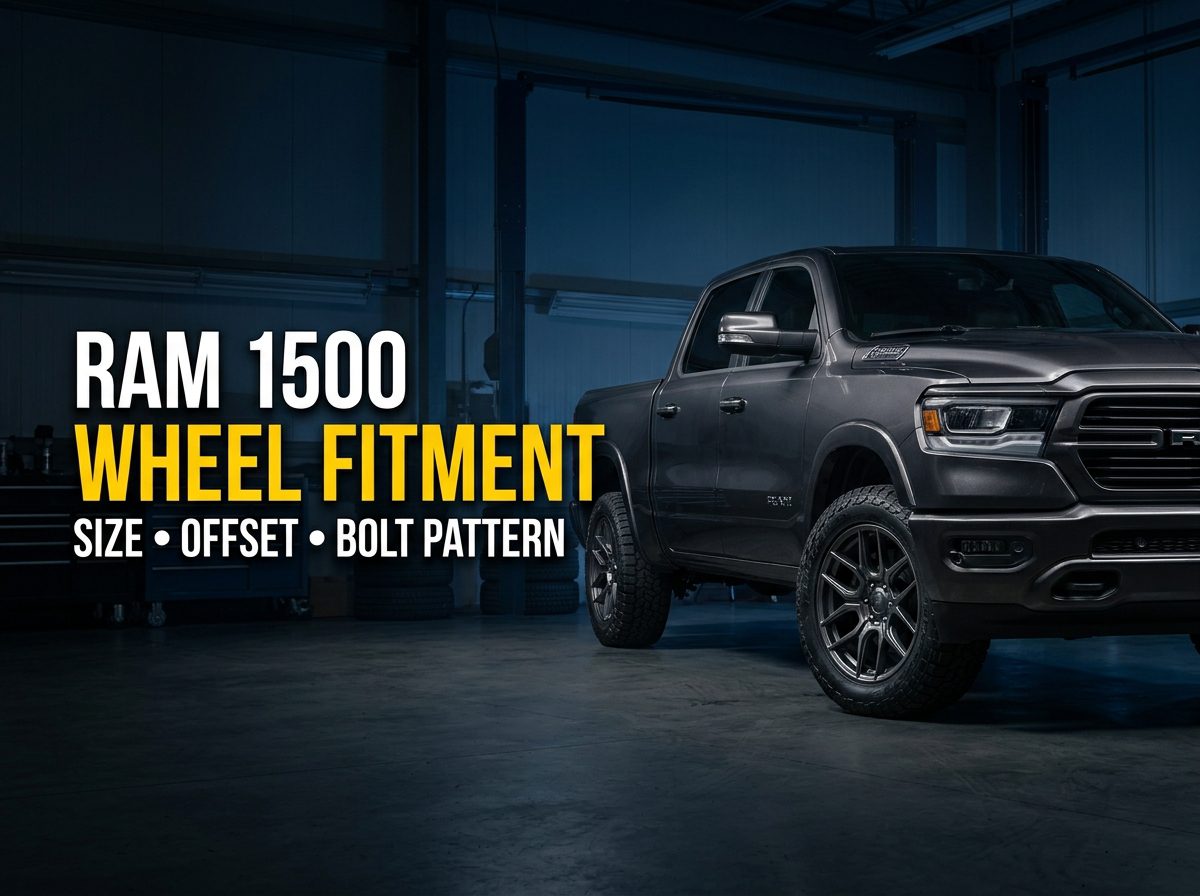
A wheel may bolt onto the hub yet still be unsuitable if it contacts suspension or brake components, protrudes too far beyond the fender, or lacks sufficient load capacity for the vehicle. This guide explains the measurements and generation-specific checks to make before buying.
Whether your truck is a 2002–2008 third-generation DR, a 2009–2018 DS, a 2019–2024 Ram 1500 Classic, or a 2019–2026 DT, begin by identifying its exact body style and model year. Ram sold the DS Classic and redesigned DT side by side, so the badge and model year alone are not enough to select a wheel.
Key Ram 1500 Wheel Fitment Facts
- The 2019–2026 redesigned DT Ram 1500 uses a six-lug 6×139.7 mm (6×5.5 in) bolt pattern.
- The 2019–2024 Ram 1500 Classic retains the five-lug 5×139.7 mm pattern.
- The 2002–2008 third-generation Dodge Ram 1500 uses a five-lug 5×139.7 mm (5×5.5 in) pattern.
- The 2009–2018 fourth-generation Ram 1500 also uses a five-lug 5×139.7 mm (5×5.5 in) pattern.
- A 77.8 mm center bore is commonly listed for these generations.
- Wheel width and offset affect suspension and fender clearance.
- A larger wheel does not automatically allow a larger tire.
- Always check wheel load capacity, tire ratings, brake clearance, and the correct lug hardware.
1. Understanding Ram 1500 Wheel Fitment
Wheel fitment describes how well a wheel matches your truck’s hub, suspension, brakes, and available space inside the wheel arches. A wheel might physically attach to the hub but still be unsuitable because its inner edge contacts suspension components or its outer edge extends too far toward the fender.
There are several measurements to understand before shopping.
Wheel diameter
Wheel diameter is measured across the wheel where the tire bead seats. Common Ram 1500 factory wheel diameters include 17, 18, 20, and 22 inches, depending on the generation and configuration.
A larger wheel generally leaves less room for tire sidewall height when the overall tire diameter stays similar. This can change ride comfort and wheel protection on rough roads.
Wheel width
Wheel width is measured between the inside bead-seat surfaces, not across the outer edges. It determines which tire widths the wheel manufacturer approves for that particular wheel.
For example, a 9-inch-wide wheel and an 8-inch-wide wheel can position the tire differently even when both have the same offset. That difference matters when checking upper control arms, struts, and fender clearance.
Bolt pattern
The bolt pattern identifies the number of lug holes and the diameter of the circle passing through their centers. It must match the truck’s wheel hub exactly.
For example, 6×139.7 means six lug positions arranged around a 139.7 mm circle. The same measurement with five lug positions is written 5×139.7.
2. Ram 1500 Bolt Pattern by Generation and Model Year
This is one of the most important parts of the buying process. Ram sold two different 1500 body styles at the same time between 2019 and 2024. The newer DT and the older DS Classic do not share the same wheel bolt pattern.
| Ram 1500 version | Model years | Bolt pattern | Center bore |
|---|---|---|---|
| Fourth-generation DS | 2009–2018 | 5×139.7 mm | 77.8 mm |
| Ram 1500 Classic DS | 2019–2024 | 5×139.7 mm | 77.8 mm |
| Fifth-generation DT | 2019–2026 | 6×139.7 mm | 77.8 mm |
Important: The 2019–2024 overlap is where buyers can make an expensive mistake. A 2019 Ram 1500 Classic and a 2019 redesigned Ram 1500 are not the same wheel application.
The 2002–2008 DR generation also uses a 5×139.7 mm bolt pattern and a commonly listed 77.8 mm center bore. Published DR fitment references list 9/16-18 wheel studs, so do not assume its lug hardware matches later DS or DT models. Verify stud thread, lug-seat shape, wheel part number, and hub fit before purchasing.
The easiest quick check is to count the lug nuts: five indicates a DR or DS-family truck, while six indicates the redesigned DT. Counting lugs is only a first filter, not a complete fitment test.
Even when two wheels share the same bolt pattern, that does not guarantee compatibility. Their offset, width, center bore, lug-seat design, and brake clearance must also be checked.
Fitment references from WheelsASAP’s Ram 1500 wheel guide and the Ram 1500 Classic fitment reference provide additional generation-specific information.
3. Wheel Offset, Backspacing, and Center Bore Explained
After confirming the bolt pattern, pay close attention to offset. It determines where the wheel sits in relation to the hub mounting surface.
What does wheel offset mean?
Offset is the distance between the wheel’s mounting surface and its centerline. It is measured in millimeters.
- Positive offset: The mounting surface sits toward the outside face of the wheel, generally positioning the wheel farther inward.
- Zero offset: The mounting surface lines up with the wheel centerline.
- Negative offset: The mounting surface sits toward the inside of the wheel, generally pushing the wheel farther outward.
For many 2019-and-newer DT Ram 1500 factory applications, aftermarket fitment references list approximately +19 mm offset. However, do not assume that one offset is correct for every wheel width, trim, or tire combination.
Understanding backspacing
Backspacing measures the distance from the wheel’s mounting surface to its inside edge. It is usually expressed in inches.
Offset and backspacing are related, but they are not interchangeable measurements. A wider wheel can have the same offset as a narrower wheel while extending farther on both sides. As a rough estimate for a conventional one-piece wheel, backspacing in inches is approximately half the wheel’s overall width plus the offset converted from millimeters to inches. For example, an 8-inch nominal wheel at +19 mm is about 5.25 inches of backspacing, while a 9-inch wheel at +19 mm is about 5.75 inches. This is an estimate only: use the wheel maker’s published backspacing and actual measurements when checking clearance.
Tire Rack’s wheel fitment FAQ explains how offset and backspacing are measured and why both matter when selecting replacement wheels.
What about center bore?
The center bore is the opening in the middle of the wheel that fits over the truck’s hub. A wheel with an incorrectly sized opening may not seat properly.
Some aftermarket wheels have a larger center bore to accommodate multiple vehicles. Depending on the wheel’s centering design, a correctly sized hub-centric ring may be required. Follow the wheel manufacturer’s instructions rather than assuming every oversized center bore is acceptable.
4. Factory and Aftermarket Wheel Size Considerations
Ram 1500 factory wheel packages vary with trim, equipment, and model year. The following examples illustrate the differences, rather than providing a universal specification for every truck.
| Configuration | Example factory wheel | Example offset | Fitment consideration |
|---|---|---|---|
| 2019–2024 Ram 1500 Classic | 17×7 | +25 mm | Five-lug DS application |
| 2019–2024 Ram 1500 Classic | 20×8 | +19 mm | Five-lug DS application |
| 2019–2026 Ram 1500 DT | 18×8 | Approximately +19 mm | Six-lug DT application |
| 2019–2026 Ram 1500 DT | 20×9 | Approximately +19 mm | Check trim and brake clearance |
| Selected DT configurations | 22×9 | Approximately +19 mm | Verify exact factory application |
These examples are reference listings, not a universal specification for every trim. Fitment databases also list 18×8 +20, 19×8 +20, and 22×9 +19 as additional Classic factory-wheel examples. Common DT factory references include 18×8 +19, 20×9 +19, and 22×9 +19; selected performance models such as TRX and RHO may use 18×9 +19. Confirm the original wheel part number, trim, brake package, and exact model year before treating any size as an OEM match. See the Classic fitment reference and DT fitment reference for the listed applications.
Aftermarket wheels offer more finishes, widths, and designs. However, the appearance of a wheel should never be the deciding factor. Confirm that its dimensions and load rating are appropriate for your Ram.
If you’re researching other upgrades, our Ram aftermarket parts buying guide explains why model-year and configuration checks matter before ordering replacement or upgrade components.
5. Choosing Tire Sizes and Avoiding Rubbing Problems
Wheel selection and tire selection should be planned together. Common published original-equipment tire examples include 265/70R17 and 275/60R20 on some Ram 1500 Classic packages, and 275/65R18, 275/55R20, or 285/45R22 on some DT packages. These are examples, not universal recommendations. Exact tire size varies by year, trim, drivetrain, wheel package, and market; use the tire-and-loading placard and owner’s manual for the specific truck.
Several areas deserve attention:
- Upper control arms and suspension components.
- Struts and other inner wheel-well surfaces.
- Front fender liners and bumper edges.
- Brake calipers and wheel spokes.
- Clearance during steering and suspension movement.
For example, a wide all-terrain tire might clear the suspension while the truck is parked straight ahead but rub against the inner liner when turning fully. Tire dimensions can also differ between manufacturers, even when the sidewall displays the same nominal size.
Do larger tires require a lift kit?
Not necessarily. Some tire combinations fit within the factory suspension configuration, while others require different wheel dimensions, a leveling kit, or a suspension lift. The exact result depends on the truck’s trim, drivetrain, wheel width, offset, tire construction, and suspension setup.
A leveling kit does not guarantee clearance. It changes ride height and suspension geometry, but it does not automatically solve every tire-to-control-arm or tire-to-body clearance problem.
Before making suspension changes, review our Ram 1500 lift kit guide for compatibility, installation, and safety considerations.
After installation, inspect clearance with the steering turned in both directions and through the suspension’s available movement. Have a qualified technician inspect the combination if you are unsure.
6. Important Differences Between OEM and Aftermarket Wheels
Factory and aftermarket wheels can both work well when correctly matched to the truck. Their main differences involve design choices, specifications, availability, and the amount of fitment research required.
| Feature | OEM wheels | Aftermarket wheels |
|---|---|---|
| Vehicle fitment | Designed for specified factory applications | Depends on exact wheel specifications |
| Appearance | Factory styling | More finishes and designs |
| Dimensions | Factory-approved combinations | More width and offset choices |
| Center bore | Designed for the original hub | May require a compatible centering ring |
| Load capacity | Specified for the original application | Must be checked for the replacement wheel |
| Installation | Usually uses factory-compatible hardware | May require application-specific lug hardware or TPMS components |
One advantage of OEM wheels is that their original application is easier to identify through factory parts information. Aftermarket wheels offer more flexibility, but that flexibility makes checking specifications especially important.
For more ideas about practical upgrades, see our Ram 1500 accessories guide. Remember that an accessory or wheel package should solve a real need without compromising the truck’s original safety systems.
7. Wheel Installation, Lug Torque, and Maintenance
Correct wheel fitment is only part of the job. Proper installation is equally important.
Before installing a replacement wheel, inspect the hub mounting surface. Dirt, rust, corrosion, or loose material can prevent the wheel from sitting flat.
Use the correct lug nuts for the wheel’s seat design and the truck’s studs. A lug nut that threads onto a stud is not necessarily the correct one. Its thread, seat shape, and length must all be compatible.
Follow the correct torque specification
Do not use a generic torque figure for every Ram 1500. The required specification depends on the exact model and hardware.
For reference, the 2026 Ram 1500 owner’s manual lists:
- Lug torque: 130 ft-lb (176 N·m).
- Fastener thread: M14 x 1.50.
- Lug seat: Cone.
- Socket size: 22 mm.
The manual also instructs owners to tighten the fasteners in a star pattern, avoid oiling the studs, and recheck torque after 25 miles (40 km). These figures apply to the specified 2026 application, not automatically to every earlier Ram.
Check TPMS compatibility
The Tire Pressure Monitoring System (TPMS) uses sensors to monitor tire pressure. Some aftermarket wheels may require compatible sensors or additional installation work.
The 2026 Ram owner’s manual warns that the TPMS is optimized for original equipment wheel and tire specifications and that incompatible replacement equipment can cause system problems or sensor damage.
After changing wheels, confirm that the TPMS operates correctly and that all four tires have the appropriate cold inflation pressure specified for the truck’s application.
8. How to Check Wheel Compatibility Before Buying
Before ordering wheels, collect the following information:
- Model year: Confirm the exact production year.
- Generation: Identify whether your truck is a DS Classic or DT.
- Trim: Record the Tradesman, Big Horn, Laramie, Rebel, or other trim designation.
- Bolt pattern: Confirm the number of lugs and bolt-circle measurement.
- Wheel dimensions: Check diameter and width.
- Offset and backspacing: Compare them with the truck’s original configuration and the wheel manufacturer’s application data.
- Center bore: Confirm hub compatibility and any centering-ring requirements.
- Brake clearance: Verify that the wheel clears the brake calipers.
- Load rating: Ensure the wheel can support the required vehicle loads.
- Tire compatibility: Check approved tire width, diameter, load index, and speed rating.
Do not rely only on a seller’s statement that a wheel fits a Ram 1500. Ask for the exact year, generation, trim, wheel dimensions, and applicable installation hardware.
Your VIN can help a dealership or parts specialist identify the original equipment configuration. You can also consult our 1500 Ram parts fitment checklist before ordering other vehicle-specific components.
For additional upgrade considerations, our 2026 Ram accessories guide discusses why modern truck modifications need to work with existing vehicle equipment.
Finally, review the vehicle’s tire and loading information placard and applicable owner’s manual. The manufacturer’s approved tire and wheel sizes, load ratings, and inflation recommendations take priority over generic aftermarket fitment suggestions.
Sources and Fitment References
- 2026 Ram 1500 Owner’s Manual (Mopar) for model-specific operating, tire-pressure, TPMS, and wheel-fastener guidance.
- 2002–2008 Dodge Ram 1500 DR fitment reference.
- 2019–2024 Ram 1500 Classic fitment reference.
- 2019–2026 Ram 1500 DT fitment reference.
- Tire Rack wheel and tire fitment FAQ for measurement concepts and tire-selection guidance.
Editorial note: MyRamCare is an independent informational site and is not affiliated with or endorsed by Ram or Stellantis. Fitment tables are starting points, not vehicle-specific approval. Verify measurements against the VIN, factory parts information, the wheel manufacturer’s application data, and a qualified installer before driving.
Conclusion: Get the Measurements Right Before Ordering
Successful Ram 1500 wheels fitment starts with identifying the correct truck generation and matching the wheel’s bolt pattern. From there, check diameter, width, offset, center bore, brake clearance, tire dimensions, and load capacity.
Pay particular attention to the difference between the five-lug Ram 1500 Classic and the six-lug DT model. They may share the Ram 1500 name, but their wheels are not interchangeable.
The best wheel upgrade is not necessarily the biggest or widest option. Choose a properly rated wheel and tire combination that clears the suspension, maintains safe handling, and matches your truck’s approved specifications.



0 Comments