
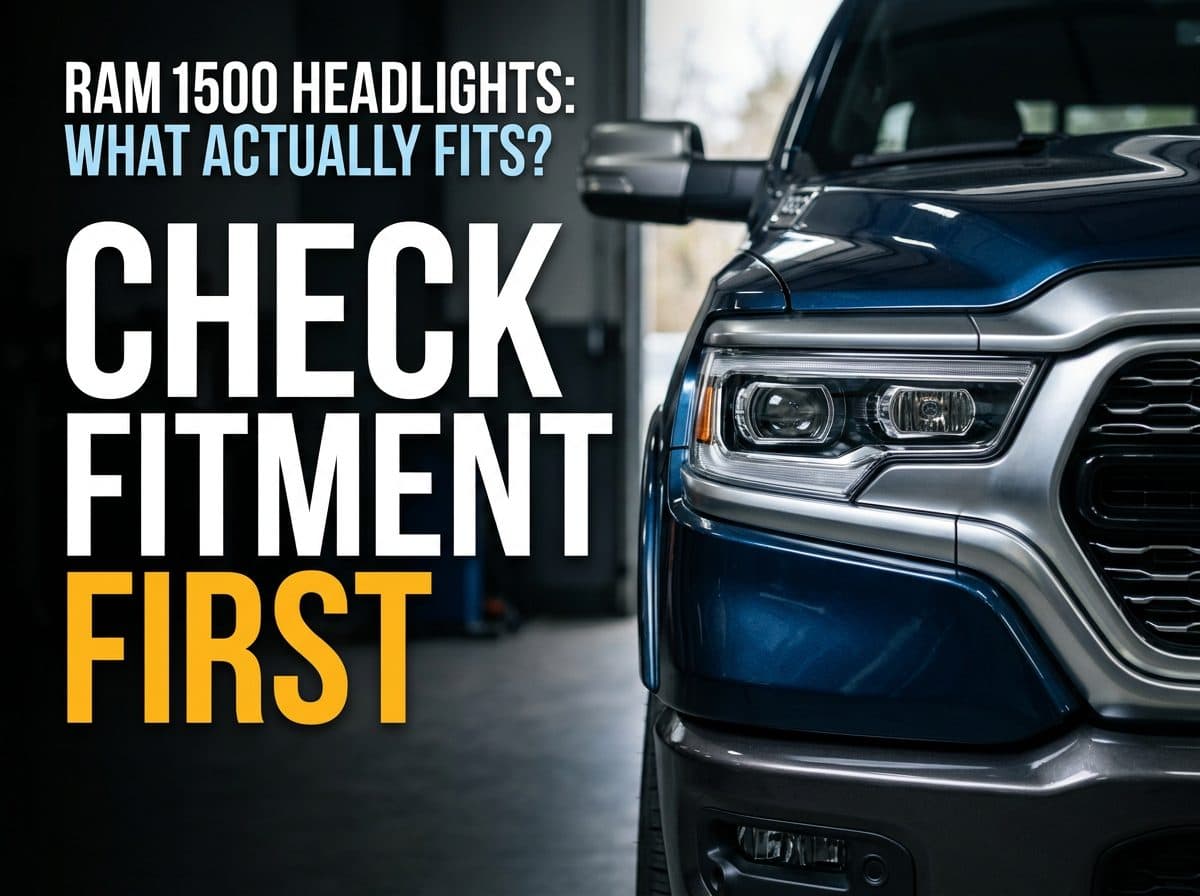
That matters when you’re replacing a damaged housing, fixing a failing headlight, or upgrading the truck’s appearance. A headlight that looks almost identical in a product photo may have a different connector, mounting arrangement, lighting system, or electronic requirement. Before ordering anything, identify the equipment your truck left the factory with.
Key facts about Ram 1500 headlight assemblies
- Model year alone is not enough to confirm headlight compatibility.
- Some model years have multiple factory headlight configurations.
- Ram 1500 Classic and redesigned DT trucks must not be treated as one interchangeable parts group.
- Halogen reflector, LED reflector, and LED projector assemblies are different options.
- Driver-side and passenger-side assemblies have separate part applications.
- Light condensation does not always mean the headlight needs replacement.
- Check the VIN, factory equipment, connector, and part number before ordering.
What a Ram 1500 headlight assembly includes
A headlight assembly is the complete lighting housing fitted to the front of the truck. Depending on the factory configuration, it may contain a reflector or projector, light sources, lens, internal reflectors, wiring connections, mounting points, and other lighting components.
The clear outer lens protects the internal parts from dirt, water, and road debris. Behind it, the reflector or projector helps direct light toward the road. The assembly may also include daytime running lights, position lights, turn-signal functions, and other features depending on the particular truck.
It is important to distinguish a complete headlight assembly from a replacement bulb. On a bulb-serviceable halogen system, a failed bulb may be replaced separately when the housing and other components are still in good condition. An integrated LED system can have a different service procedure and may require attention to the complete assembly or its designated service components.
For owners trying to identify other exterior lighting equipment, our guide to RAM 1500 mirrors and their different features explains why factory equipment and electrical connections matter when choosing replacement exterior parts.
Why model year and factory configuration matter
The first step is identifying which Ram 1500 you’re working on. The older Ram 1500 Classic and the redesigned DT-generation Ram 1500 are not automatically interchangeable just because their model years overlap. Parts catalogs list separate applications for these vehicle groups.
For example, the 2024 Ram 1500 Classic has its own headlamp parts listings. The redesigned 2023 Ram 1500 DT catalog separately identifies halogen, LED with Adaptive Front Lighting System, and LED without Adaptive Front Lighting System configurations. Those are not simply different names for the same housing.
Factory trim and appearance details matter as well. A parts catalog can distinguish between assemblies by lighting type, driver or passenger side, bezel finish, and special vehicle applications. A replacement may look similar from the front but still have the wrong mounting points or electrical connections.
Before shopping, collect these details:
- Model year: Confirm the exact year shown in your vehicle records.
- Vehicle generation: Determine whether it is a Ram 1500 Classic or the redesigned DT model.
- Trim: Record the trim and any relevant appearance or equipment package.
- Factory lighting: Identify whether the truck has halogen, LED reflector, or LED projector headlights.
- Side: Establish whether you need the driver-side or passenger-side assembly.
When the truck’s equipment is uncertain, use its VIN with a Ram dealer or a reliable parts catalog to confirm the original application. Our Ram 1500 parts and accessories fitment guide also explains why checking the exact vehicle application is more useful than relying on a broad model-year label.
Halogen, LED reflector, and LED projector headlights
One of the most important differences is the lighting technology inside the housing. A replacement advertised simply as a Ram 1500 headlight may not match the system installed on your truck.
Halogen reflector headlights
A halogen reflector system uses replaceable bulbs and a reflector to distribute light. The bulb type must match the housing and the vehicle’s specified application. The 2023 Ram 1500 owner’s manual, for example, lists an H11LL low-beam bulb and a 9005LL high-beam bulb for the equipped halogen reflector headlamp. Those bulb numbers should not be assumed to apply to every Ram 1500 model year or configuration.
LED reflector headlights
An LED reflector assembly uses LED lighting elements with a reflector-based optical design. It is a different factory configuration from a halogen reflector system. The 2023 owner’s manual lists the LED reflector configuration separately and directs owners to an authorized dealer for LED bulb replacement.
LED projector headlights
A projector system uses a lens-based optical design to control the light beam. It may have a different internal layout and equipment application from an LED reflector assembly. A projector-style replacement should not be assumed to fit an LED reflector-equipped truck just because both use LED lighting.
Some catalog applications also identify adaptive front lighting separately. That is another reason to confirm the original equipment rather than ordering by appearance alone.
| Headlight type | Basic design | Important fitment check |
|---|---|---|
| Halogen reflector | Replaceable halogen bulb with reflector optics | Confirm the specified bulb, housing, connector, and vehicle application |
| LED reflector | LED lighting with reflector-based optics | Match the factory LED reflector configuration and equipment |
| LED projector | LED lighting with projector optics | Confirm projector type, side, trim, and electronic compatibility |
| Adaptive LED | LED assembly with adaptive lighting equipment | Verify the adaptive front lighting application specifically |
The table shows why descriptions such as “fits Ram 1500” are not enough. Your replacement needs to match the original lighting design and the catalog application for your truck.
OEM, aftermarket, and used assemblies compared
Once you have confirmed the factory configuration, you can compare replacement options. Original equipment, aftermarket, and used assemblies each have trade-offs. The right choice depends on the condition of your current light, your budget, and how closely you need to preserve the original equipment.
| Replacement option | Potential advantages | Things to check |
|---|---|---|
| OEM assembly | Designed for the original vehicle application | Confirm the exact part number, side, and equipment code |
| Aftermarket assembly | May offer different styling or replacement choices | Verify fitment, beam performance, connector, mounting points, and warranty |
| Used OEM assembly | May provide an original-style replacement | Inspect lens condition, mounting tabs, moisture, and part-number match |
An OEM replacement is a sensible starting point when you want to maintain the factory lighting configuration. However, the word OEM does not remove the need to verify the part number and vehicle application. A genuine assembly for a different trim or lighting package can still be the wrong choice.
Aftermarket assemblies can offer alternative appearance options, but quality and fitment vary. Read the complete application details rather than relying on a product title. Look for a clear statement covering your truck’s year, generation, trim, original headlight type, and side. Check whether the listing includes the necessary wiring or describes a separate harness.
A used assembly deserves a careful inspection. Look for cracked lenses, broken mounting tabs, damaged connectors, signs of previous repairs, and persistent moisture inside the housing. Ask for clear photos of the part label and rear connector before purchasing.
Our guide to Dodge truck aftermarket parts and fitment checks covers additional things to examine before selecting a non-factory replacement.
Common headlight problems and what they may indicate
A failed headlight does not automatically mean the entire assembly needs replacement. The cause may be a bulb, connector, fuse, wiring problem, damaged housing, or an internal lighting-system issue. Identifying the symptom first can help prevent buying a part that does not solve the problem.
One headlight is not working
If only one side stops working, the problem may be isolated to that lamp, its bulb where replaceable, the connector, wiring, or a related control. Start by checking the owner’s manual for the correct lighting configuration and service information. Do not assume a bulb failure when the truck has an integrated LED system.
Both headlights are not working
When both sides stop working, investigate the relevant power supply, control system, and vehicle-specific electrical information. A fuse may be involved, but fuse positions and circuits can differ by model year and equipment. Avoid installing a random replacement fuse or relying on a diagram for another Ram model.
Our article on the Ram 1500 mirror fuse location explains why checking the correct vehicle diagram matters. It is about the mirror circuit, not a headlight fuse chart, so use your own owner’s manual for the headlight circuit rather than transferring a fuse number from another system.
Condensation or moisture inside the lens
Some light fogging can occur when a headlamp warms up and then cools rapidly. Weather changes, rain, and washing can contribute to temporary condensation. A light film that begins to clear is not necessarily proof that the assembly has failed.
Persistent moisture, large water droplets, or visible water collecting inside the housing deserve closer attention. Damaged lenses, seals, access caps, vent components, or bulb sockets can allow water to enter. The correct response depends on the vehicle and the manufacturer’s diagnostic guidance, not on an assumption that every fogged headlight needs replacing.
The replacement connector does not match
A connector mismatch is a warning that the replacement may be for a different factory lighting configuration. Ram owners discussing halogen-to-LED changes and replacement housings have raised questions about harness differences. Those discussions are useful for identifying the kind of problem people encounter, but they are not a substitute for a verified application or wiring diagram.
Do not cut the factory harness or improvise wiring just to make a replacement fit. Confirm whether the part is a direct replacement or a conversion kit, and follow the manufacturer’s instructions for any approved conversion.
What the owner’s manual, service bulletins, and recalls say
Manufacturer information is especially important when dealing with modern LED lighting. The 2023 Ram 1500 owner’s manual separates the halogen reflector, LED reflector, and LED projector lighting configurations. It identifies the halogen bulb types for the equipped halogen system and advises owners to see an authorized dealer for LED bulb replacement.
There is also an important difference between installing a complete replacement headlamp and putting an LED bulb into a headlamp designed for a replaceable halogen bulb. In a February 2024 interpretation, NHTSA explained how Federal Motor Vehicle Safety Standard No. 108 applies to these lighting designs. A complete integral-beam LED headlamp must meet the applicable requirements; an LED replacement bulb is not automatically an approved substitute for a replaceable-bulb headlamp. Vehicle owners should also consider applicable state requirements.
Condensation has its own service guidance. Stellantis published bulletin 23-004-24 for 2021–2024 Ram 1500 DT trucks covering a headlamp condensation-clearing procedure. It describes a service-bay evaluation in which the lamp is operated for 20 minutes. If the light fogging begins clearing, the bulletin says the lamp does not require replacement for that condition. Persistent moisture or large droplets call for further diagnosis. An earlier bulletin covers 2019–2022 DT trucks.
Recall checks matter too. NHTSA recall 24V-942 covered a small group of potentially affected 2025 Ram 1500 trucks with incorrect headlamp module software that could cause the lamps to become inoperative. The reported population was 53 vehicles, not every 2025 Ram 1500. The remedy involved a dealer software update. Check your VIN through the NHTSA recall lookup rather than assuming your truck is included or excluded based only on its year.
How to verify the correct assembly before ordering
Take a few minutes to confirm the application before paying for a replacement. This is especially important for online listings that combine several model years or describe multiple headlight styles under one product page.
- Confirm the model and generation. Identify whether your truck is a Classic or redesigned DT model.
- Record the trim and equipment. Check the factory lighting option and any relevant package details.
- Identify the side. Confirm whether the damaged part is on the driver or passenger side.
- Check the part number. Use the original label, VIN-based parts lookup, or a dealer parts department to identify the correct application.
- Compare the connector. Check the rear plug and any required electrical connections against the replacement listing.
- Review the full product application. Make sure the seller explicitly lists your year, generation, lighting type, and trim where applicable.
- Check the return policy. A clear return process is useful when a catalog listing or vehicle history leaves any uncertainty.
If a seller says a headlight fits a broad year range but does not identify the lighting configuration, ask for clarification before ordering. A listing that only says “Ram 1500” does not establish that it fits a particular factory LED or halogen setup.
For electrical or lighting upgrades, be equally careful about related exterior components. Our guide to Ram 1500 mirror turn-signal problems discusses how connectors and electrical faults can affect exterior lighting functions.
Installation, aiming, and the safest next step
Replacing a complete headlight assembly may involve access through the front of the vehicle, removal of surrounding trim, electrical disconnection, and correct installation of the housing. The exact procedure varies by model year and configuration. Use the service information for your particular truck instead of following a generic video that may show a different front-end design.
Before installation, compare the replacement with the original part. Check the mounting points, connector location, lens shape, and part label. Never force a connector or mounting tab into place. If the assembly requires a conversion harness or electronic configuration, confirm that the manufacturer specifically supports that application.
After installation, test the low beams, high beams, turn signals, daytime running lights, and other functions fitted to your vehicle. Check for warning messages and make sure the housing is secure. Headlight aim is also important: a lamp that points too high can disturb oncoming drivers, while one aimed too low can reduce the driver’s view of the road. Follow the vehicle-specific aiming procedure or have a qualified shop check it.
If the truck has integrated LED lighting, adaptive features, damaged wiring, or a persistent moisture problem, professional diagnosis may be the safer option. Avoid making changes to the factory wiring unless the replacement manufacturer provides a verified procedure for your exact configuration.
The main takeaway: choose a replacement by the truck’s actual factory equipment, not by appearance or model year alone. Confirm the generation, lighting type, side, connector, and part number before ordering. That simple check can prevent an expensive mismatch and help keep your Ram 1500’s headlights working as intended.





0 Comments