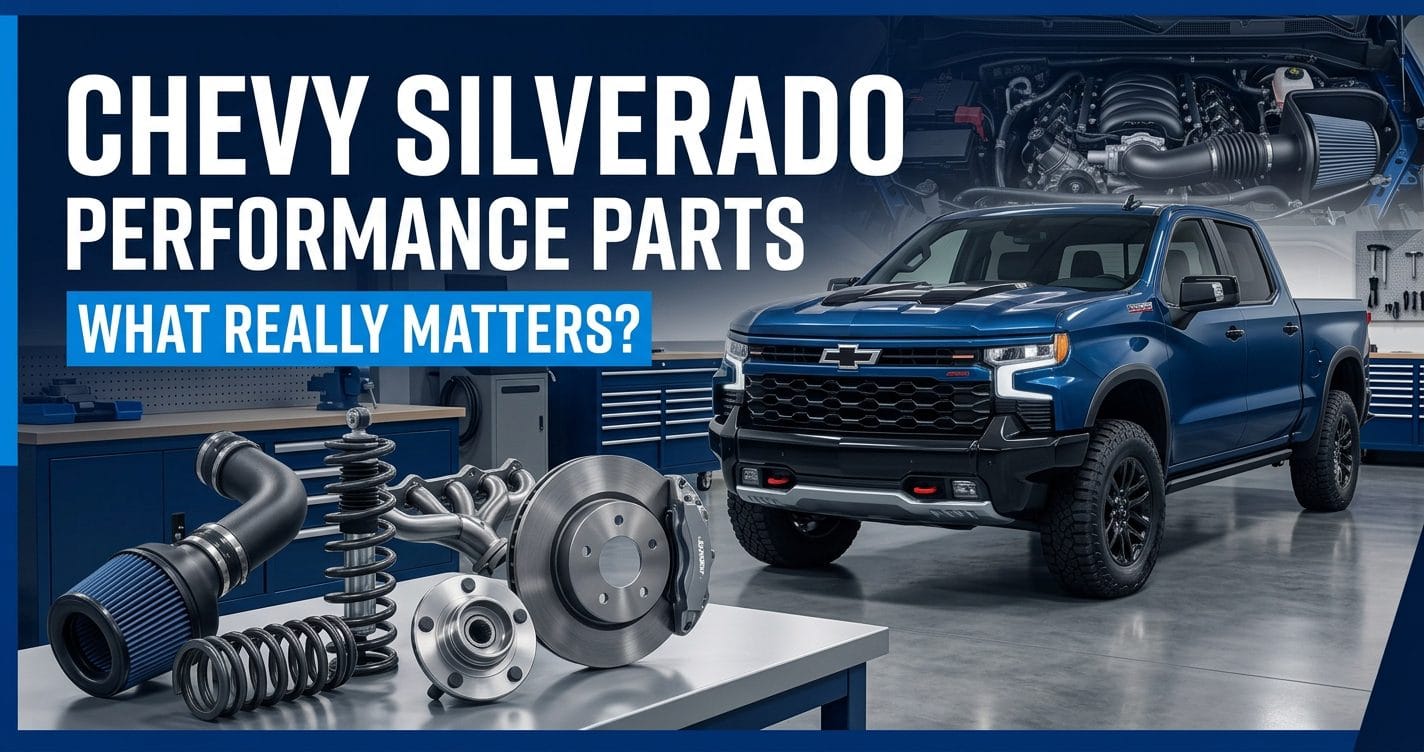
Chevy Silverado performance parts can change how a truck accelerates, sounds, handles, and responds when towing or driving off-road. But not every upgrade delivers a noticeable improvement, and some modifications can create new maintenance costs or reliability concerns.
For Silverado owners researching upgrades in 2026, the real question is not simply how to make more horsepower. It is how to improve the truck without sacrificing the qualities that make it useful every day.
This guide explains the main types of Chevy Silverado performance parts, what they actually do, how they compare, and what owners should understand before changing a factory-built truck.
What Are Chevy Silverado Performance Parts?
Chevy Silverado performance parts are components designed to change a truck’s power delivery, airflow, exhaust sound, suspension behavior, braking, or overall driving response.
Some parts make a measurable difference in engine output. Others improve handling, ground clearance, or driver control. A few mainly change the truck’s appearance or sound, even when their performance benefits are limited.
The right choice depends on the Silverado’s model year, engine, transmission, trim, and intended use.
For example, a Silverado 1500 used for commuting has different needs from a truck that regularly pulls a heavy trailer or travels on rough trails. A modification that works well for one setup may be unnecessary or unsuitable for another.
Common categories of performance parts
- Cold-air intake systems: Change how air enters the engine and may alter engine sound.
- Performance exhaust systems: Change exhaust flow and sound; results depend on the engine and complete setup.
- Engine tuning: Adjusts computer-controlled settings such as ignition timing, fueling, and transmission behavior.
- Suspension upgrades: Change ride height, handling characteristics, and off-road capability.
- Brake upgrades: Help manage heat and stopping performance when correctly matched to the vehicle.
- Engine hardware: Camshafts, headers, and other internal or external components can support larger power increases but may require additional supporting modifications.
The important distinction is that these upgrades do different jobs. An exhaust system cannot automatically fix a transmission problem, and a lift kit does not create additional engine horsepower.
Why Silverado Performance Upgrades Matter in 2026
Modern pickup trucks combine computer-controlled engines, emissions equipment, automatic transmissions, and sophisticated driver-assistance systems. That makes modifications more complicated than simply installing a larger intake or louder muffler.
Engine design matters, too. Silverado models have used several engine families and configurations across different generations. A modification suitable for an older 5.3-liter V8 may not be appropriate for a newer engine or a turbocharged powertrain.
Owners also need to consider how they use their trucks. Daily driving, towing, off-road travel, and track use place different demands on the engine, cooling system, tires, transmission, and brakes.
That is why compatibility and the intended result should come before the parts list.
For broader truck maintenance context, explore RAM Care Pro’s maintenance and repair resources.
5 Main Types of Chevy Silverado Performance Parts
1. Cold-air intakes
A cold-air intake changes the path through which air reaches the engine. Some systems use a different air filter, intake tube, or airbox arrangement.
The potential benefit depends on whether the original intake restricts airflow under the conditions being tested. If the factory system already supplies enough air, replacing it may produce little measurable power improvement.
An aftermarket intake can also make induction sounds more noticeable. That may be part of the appeal, but a louder engine is not proof of a faster truck.
Before changing the intake, check filter protection, heat exposure, sensor compatibility, and whether the system is approved for your truck’s emissions requirements.
2. Performance exhaust systems
Exhaust upgrades range from a replacement muffler to a cat-back system or a more extensive exhaust modification.
A cat-back system generally replaces exhaust components downstream of the catalytic converters. Depending on its design, it can change sound and may reduce restrictions, although the actual power gain varies by engine and setup.
Owners should pay attention to cabin drone, especially at highway speeds. A truck that sounds exciting during a short acceleration run may become tiring on a long commute.
Avoid assuming that removing emissions equipment is a harmless shortcut. Such changes can violate federal or state requirements and interfere with emissions testing.
3. Engine tuning and programmers
Engine tuning changes the software settings that control how the powertrain operates. Depending on the truck, a properly developed calibration may improve throttle response, alter shift behavior, or increase engine output.
However, tuning is not a universal fix. Results depend on the engine, fuel grade, existing modifications, transmission, and calibration quality.
More aggressive settings may increase heat, cylinder pressure, or stress on drivetrain components. A tune designed for one model year or engine configuration should not be assumed to work safely on another.
Owners should also check whether a proposed tune affects factory warranty coverage, emissions compliance, or required diagnostic systems.
4. Suspension and handling upgrades
Suspension parts can make a major difference in how a Silverado behaves, even though they do not directly add engine power.
Shocks, springs, sway bars, control arms, and properly engineered suspension systems can change body control, ride comfort, and off-road performance.
Lift kits and leveling kits need particular attention. Changing ride height or installing larger tires can affect alignment, steering geometry, braking behavior, and drivetrain angles. Heavier tires may also reduce acceleration and increase fuel consumption.
A suspension upgrade should match the truck’s actual purpose rather than simply its appearance.
5. Braking and supporting components
More engine power is useful only when the rest of the truck can handle the added demands. Brakes, tires, cooling, and transmission condition all matter.
Brake upgrades may help when a truck experiences repeated heavy braking or operates under demanding conditions, but bigger components are not automatically better for every driver. The complete system must be compatible.
If a Silverado regularly tows, the priority should be a healthy braking system, suitable tires, proper loading, and compliance with the truck’s towing limits—not horsepower alone.
Chevy Silverado Performance Parts Comparison
The following table compares common modification types by their main purpose and trade-offs. These are qualitative comparisons, not guaranteed horsepower figures.
| Upgrade | Main purpose | Potential benefit | Main trade-off |
|---|---|---|---|
| Cold-air intake | Engine airflow | Sound and possible airflow improvement | Gains may be small |
| Cat-back exhaust | Exhaust flow and sound | Different exhaust tone; possible power improvement | Noise, cost, and fitment |
| Engine tune | Powertrain calibration | Improved response or power, depending on setup | Heat, drivetrain stress, compliance concerns |
| Suspension upgrade | Ride and handling | Better control for the intended use | Cost, alignment, altered ride |
| Larger tires | Traction and clearance | More capability in suitable terrain | Added weight, gearing effects, fuel use |
| Brake upgrade | Stopping performance | Better heat management when properly matched | Cost and compatibility |
| Forced induction | Major engine power increase | Substantial potential power gain | High cost and greater supporting-system demands |
Mobile reading tip: On narrow screens, view the comparison table in landscape mode or scroll horizontally if your WordPress theme supports horizontally scrollable tables. The table is designed to compare one factor at a time rather than overwhelm readers with technical specifications.
How do aftermarket parts compare with factory equipment?
Factory components are engineered as part of a complete vehicle package. Their performance is balanced against durability, emissions requirements, noise, cost, and everyday usability.
Aftermarket components can improve a specific area, but they may change that balance. For example, a more aggressive exhaust can deliver the sound an owner wants while making highway travel less comfortable.
Chevrolet Performance also publishes installation guidance, warranty information, and emissions disclosures. Those resources are useful starting points when evaluating whether a particular modification is appropriate for a given application.
Read the official Chevrolet Performance owner support information before making decisions about specialized performance components.
What Silverado Owners and Enthusiasts Say
Online owner discussions reveal a recurring disagreement: some drivers value sound and throttle response, while others want clear power gains or better long-term reliability.
In a 2026 discussion on r/Silverado, owners considered intake changes, exhaust upgrades, and tuning for an older 5.3-liter V8. The replies differed on the value of intake modifications, with some emphasizing the limited gains of bolt-on parts and others favoring a combination of airflow changes and calibration.
Read the Reddit discussion about engine modification choices.
Another discussion about first-time Silverado modifications shows that owners often have different goals, ranging from exhaust sound to suspension improvements and general convenience. Those goals matter because not every popular truck modification is a performance upgrade.
See the Reddit discussion about first-time Silverado mods.
These posts are examples of owner experiences, not controlled engineering tests. Reported results can depend on the specific truck, installation, maintenance history, and how performance is measured.
The useful lesson is to separate three questions: Does the modification feel different? Does it produce a measurable improvement? And does that improvement justify the cost and possible downsides?
Reliability, Warranty, and Emissions: What to Check
Performance modifications can affect more than acceleration. Engine calibration, exhaust changes, and added power may influence operating temperatures, drivetrain loads, fuel requirements, and emissions-system behavior.
Before modifying a truck, consider these points:
- Start with maintenance. Resolve misfires, warning lights, fluid leaks, cooling issues, and transmission concerns before adding performance parts.
- Check exact fitment. Confirm the model year, engine code, transmission, drivetrain, and emissions configuration.
- Understand warranty terms. A modification does not automatically erase every warranty obligation, but damage associated with a modification may not be covered. Ask the manufacturer or dealer about the specific situation.
- Confirm legal compliance. Parts and calibrations must meet applicable federal and state requirements. Some competition parts are not legal for public-road use.
- Keep records. Save installation instructions, calibration details, maintenance receipts, and original components where practical.
Chevrolet’s official support page specifically warns that some Chevrolet Performance parts are intended for competition use and may not meet emissions standards for use in a particular area. Read the official emissions and warranty information before proceeding.
For a daily-driven truck, a modest, well-matched modification is often more sensible than chasing the highest possible output.
How to Choose a Performance Direction for Your Silverado
Instead of starting with a brand or a popular online modification, start with the problem you want to solve.
If you want better acceleration: Establish the truck’s baseline condition and investigate whether engine tuning or hardware changes are appropriate for its exact configuration.
If you want a deeper exhaust sound: Compare exhaust designs and consider highway drone, noise limits, and emissions requirements.
If you drive off-road: Focus on suspension geometry, tire fitment, ground clearance, and underbody protection. Engine power alone will not make a truck more capable on difficult terrain.
If you tow regularly: Prioritize cooling-system health, transmission condition, tires, brakes, payload limits, and correct trailer setup. A power increase should never be treated as permission to exceed the truck’s ratings.
If reliability is the main goal: Maintain the truck, use the correct fluids and service intervals, and investigate known concerns for the specific engine and model year before modifying anything.
You can also browse RAM Care Pro’s truck accessory and maintenance information for related pickup-truck ownership topics.
Key Facts at a Glance
- Chevy Silverado performance parts can affect engine power, exhaust sound, handling, braking, and off-road capability.
- Cold-air intakes and exhaust changes do not guarantee large horsepower gains.
- Engine tuning can change performance and shift behavior, but compatibility and calibration quality matter.
- Larger tires and lift kits can affect acceleration, fuel economy, alignment, and braking.
- Towing demands a balanced, healthy vehicle—not just a powerful engine.
- Warranty coverage and emissions legality must be checked for the specific part and truck.
- Owner forums are useful for identifying questions and real-world concerns, but anecdotes are not controlled test results.
The Bottom Line: Match the Upgrade to the Job
The best approach to Chevy Silverado performance parts is to define the goal first, verify the truck’s condition, and choose modifications that work together.
A carefully selected suspension upgrade may deliver more practical value to an off-road driver than an engine modification. A conservative calibration may suit one owner, while a stock setup may be the smarter choice for someone who depends on the truck for daily work and towing.
The key is not installing the most parts. It is making a measurable improvement without creating problems that cost more than the upgrade was worth.







0 Comments