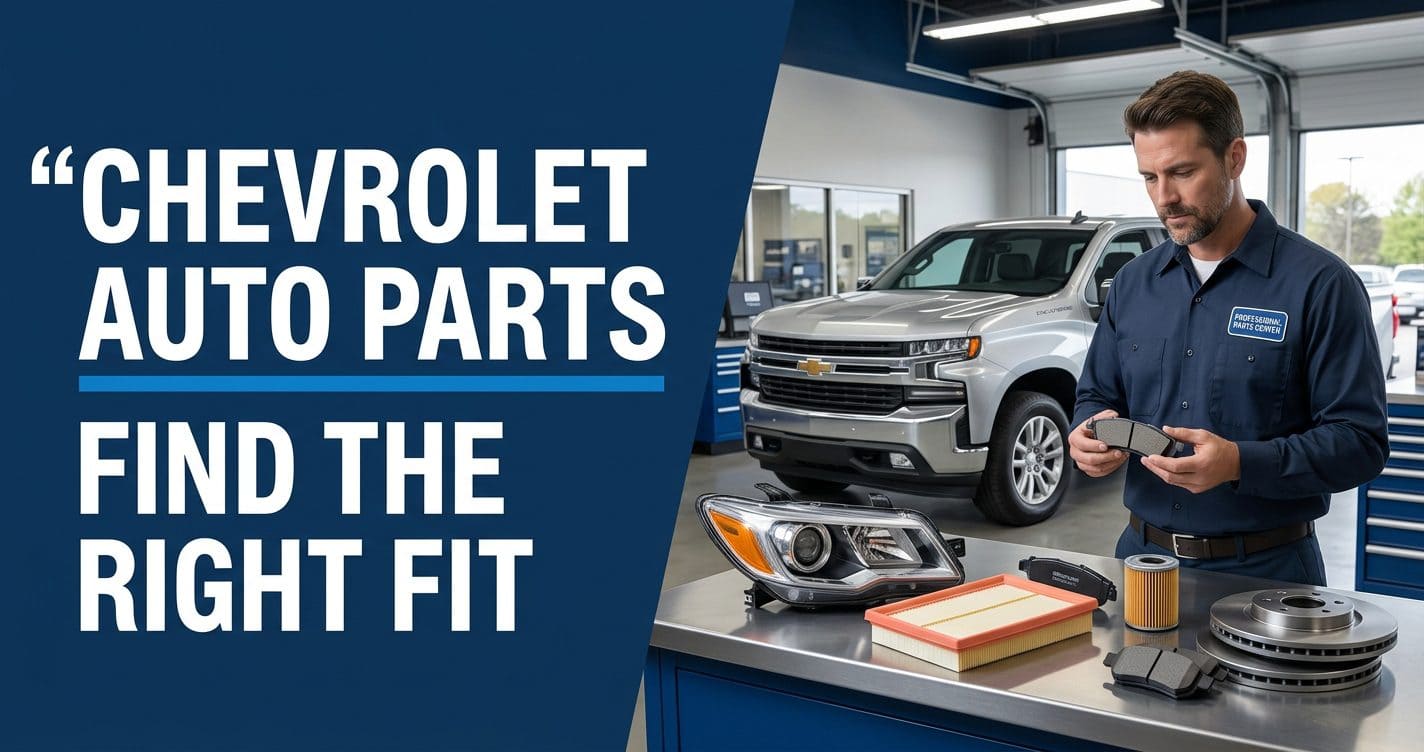
Chevrolet Auto Parts Near Me: Find the Right Part Faster
Searching for chevrolet auto parts near me usually means you have a repair to finish, a warning light to investigate, or a Chevrolet that needs a replacement part before your next commute. The challenge isn’t simply finding a nearby store. It’s finding the correct part for your exact vehicle without wasting time on a return, an unnecessary repair, or a component that doesn’t fit.
In 2026, drivers have more ways to locate replacement parts, including local auto parts stores, Chevrolet dealerships, independent suppliers, and auto recycling yards. Each option has advantages, but the right choice depends on your vehicle, the repair, and how quickly you need the part.
This guide explains where to look, how to check compatibility, and what to consider before making a decision.
What Does Chevrolet Auto Parts Near Me Actually Mean?
When people search for Chevrolet auto parts near me, they may be looking for anything from an oil filter for a Silverado to a replacement headlight for a Malibu or an electronic module for a Tahoe.
Local results can include several types of businesses:
- Auto parts retailers: Stores that carry common maintenance and repair items, such as filters, batteries, belts, and brake components.
- Chevrolet dealerships: Parts departments that can identify genuine GM parts and help with vehicle-specific components.
- Independent parts suppliers: Businesses that supply original-equipment and aftermarket components.
- Auto salvage yards: Recyclers that sell usable components removed from other vehicles.
- Independent repair shops: Garages that may source the part and handle installation at the same time.
The important distinction is that a nearby store may not have your exact part in stock. A listing on a map doesn’t guarantee local availability, correct fitment, or same-day pickup.
Why the exact Chevrolet model matters
A Chevrolet Silverado 1500 and Silverado 2500HD may look similar, but many components differ. Even two Silverados from the same model year can require different parts depending on engine, drivetrain, trim, production changes, and installed equipment.
The same issue applies to the Equinox, Traverse, Colorado, Camaro, and other Chevrolet models.
Start with your vehicle’s details rather than assuming that a part advertised for a Chevrolet will fit every Chevrolet.
Why Finding the Right Part Matters in 2026
Modern vehicles combine traditional mechanical components with increasingly sophisticated electronics. A replacement air filter is usually straightforward to identify. An engine control module, sensor, infotainment unit, or advanced lighting component can require much more careful matching.
That makes accurate identification especially important when a vehicle has several engine options or different equipment packages.
Chevrolet’s official parts and accessories help guide recommends using the Vehicle Identification Number (VIN) to refine part selection. It also identifies year, make, model, and existing part number as alternative ways to search.
Your VIN is a 17-character identifier that helps distinguish your specific vehicle. You can usually find it on the driver’s-side dashboard near the windshield, the driver’s-side door area, or your registration and insurance documents.
What can go wrong when compatibility is overlooked?
An incorrect part can cause more than an inconvenient return.
- A brake component that doesn’t match the application can delay an important safety repair.
- An electrical component may have the wrong connector or require programming.
- A body panel may not align with the vehicle’s mounting points.
- A suspension component may differ between two-wheel-drive and four-wheel-drive versions.
- A replacement part may fit physically but still have the wrong specifications.
The takeaway is simple: confirm fitment before paying, not after opening the package.
Where to Find Chevrolet Auto Parts Near You
There isn’t one best source for every repair. The following options cover most situations.
1. Local auto parts stores
Local retailers are useful for routine maintenance and common repairs. Depending on the location, inventory may include batteries, spark plugs, filters, wiper blades, bulbs, brake pads, and other frequently replaced components.
The main advantage is convenience. You can call ahead, confirm stock, and potentially collect the part the same day.
However, less common engine components, model-specific electronics, and parts for older vehicles may need to be ordered.
2. Chevrolet dealership parts departments
Dealership parts departments are particularly useful when the repair involves a complex or vehicle-specific component.
A parts specialist can use vehicle information to help identify the correct GM part number. This can be valuable for newer vehicles, electronic modules, specialized hardware, and parts with multiple revisions.
The trade-off is that a dealership may need to order the component, and its price may differ from independent suppliers. Check availability and the total cost rather than assuming every dealership carries every item.
3. Independent parts suppliers
Independent suppliers may offer genuine GM parts, original-equipment supplier brands, and aftermarket alternatives.
This option can provide more flexibility, especially for routine maintenance and common mechanical repairs. Ask which manufacturer made the component and whether the part number is confirmed for your vehicle.
4. Auto salvage and recycling yards
Salvage yards can be useful for older vehicles, discontinued components, interior trim, mirrors, doors, and other reusable parts.
Before choosing a used component, ask about its condition, donor vehicle, mileage if known, return policy, and warranty. For safety-critical components or parts with hidden internal damage, a used part may introduce more uncertainty than the savings justify.
OEM vs. Aftermarket vs. Used Chevrolet Parts
OEM, aftermarket, and used parts are different categories, not automatic quality rankings. Each has a place, and the best fit depends on the component and repair.
| Factor | OEM / Genuine GM | New aftermarket | Used / recycled |
|---|---|---|---|
| Source | GM-branded or genuine replacement part | Third-party manufacturer | Existing donor vehicle |
| Condition | New | New | Previously used |
| Availability | May require dealer ordering | Depends on supplier and application | Depends on local inventory |
| Fitment | Designed for specified applications | Varies by manufacturer and catalog accuracy | Must match the donor and recipient applications |
| Cost | Varies; may be higher | Ranges from budget to premium | Often less than a comparable new part, but not always |
| Warranty | Depends on the part and seller | Depends on manufacturer and seller | Depends on recycler and written terms |
| Common use | Vehicle-specific or specialized repairs | Maintenance and replacement components | Trim, body parts, and selected discontinued components |
These are general characteristics, not guarantees. Actual prices, availability, quality, and warranty coverage vary by part and seller.
Which type makes sense for your repair?
For routine service items, a reputable aftermarket part may be perfectly suitable if it meets the vehicle’s specifications. For a complex electronic module or a component with multiple revisions, exact identification becomes more important than choosing by price alone.
Used parts deserve a separate check. A matching appearance does not prove matching specifications, and a used component’s remaining service life may be difficult to determine.
A Chevrolet enthusiast discussion about factory OEM versus aftermarket parts illustrates a common issue: the value of an alternative depends on the particular component, not just the label on the box.
How to Make Sure a Chevrolet Part Fits
Before visiting a store or placing an order, gather the information needed to identify the correct component.
Step 1: Record your vehicle details
Write down:
- Model year and exact Chevrolet model
- Engine size and configuration, if known
- Two-wheel drive or four-wheel drive, where applicable
- Trim level, if relevant
- VIN
- Existing part number, if available
For example, searching for a brake component for a 2021 Silverado 1500 is a starting point. Confirming the engine, drivetrain, brake configuration, and applicable part number can narrow the result considerably.
Step 2: Compare the part number
If the old component has a readable number, give it to the parts specialist. Ask whether it is the current number or whether the manufacturer has replaced it with a superseding number.
A part-number match is useful, but it should still be checked against the specific vehicle application. Similar-looking numbers can refer to different assemblies, connectors, or included hardware.
Step 3: Ask about installation requirements
Some replacement components are essentially plug-and-play. Others may require calibration, coding, relearning, or professional installation.
Ask about these requirements before collecting the part. Otherwise, a component that appears affordable can lead to additional labor, diagnostic work, or unexpected delays.
Step 4: Confirm the return policy
Ask whether the part can be returned if it doesn’t fit, whether opened packaging affects eligibility, and whether electrical parts have special restrictions. Keep the receipt and packaging until the repair is complete.
What Chevrolet Owners Say About Finding Parts
Owner forums and Reddit discussions are useful because they reveal problems that product listings don’t always explain.
In a Reddit discussion about finding aftermarket parts for a Chevrolet HHR, owners described fitment problems with parts ordered online. The discussion highlights an important distinction: a part appearing in search results doesn’t guarantee that it will fit the vehicle correctly.
Another Reddit thread about sourcing GM parts outside dealerships discusses the different roles of local parts stores, dealerships, and independent suppliers. Participants point out that ordinary maintenance parts are often easier to source than specialized components.
A Chevrolet forum discussion about using the VIN to identify parts also illustrates why identification can be more complicated than it first appears. Components that seem similar may differ in their included assemblies or exact specifications.
These are individual owner experiences, not controlled tests or proof that one supplier is always better. Their shared lesson is practical: verify the actual part number, application, and contents rather than relying on a listing title or photo alone.
How to Compare Local Parts Sources Before You Go
Use the following checklist when calling nearby stores or suppliers.
| Question | Why it matters |
|---|---|
| Is the exact part in stock? | Avoids an unnecessary trip |
| Has fitment been checked against my VIN? | Reduces compatibility errors |
| Is it new, remanufactured, or used? | Clarifies condition |
| What is the full price, including required hardware? | Makes comparisons fairer |
| Does it require programming or calibration? | Helps estimate the complete repair |
| What warranty and return terms apply? | Clarifies your options if something goes wrong |
| When can I collect it? | Helps plan around vehicle downtime |
Mobile reading tip: On a phone, swipe horizontally across the comparison table to see any columns that extend beyond the screen.
When comparing two suppliers, look beyond the part’s listed price. A cheaper component that needs extra shipping, additional hardware, or a second trip may not be the cheaper solution overall.
Common Mistakes to Avoid
A few simple checks can prevent many parts-sourcing headaches.
- Don’t assume every Chevrolet part is interchangeable. Model year, engine, drivetrain, and production variations can matter.
- Don’t rely on photographs alone. Similar-looking components may have different dimensions or connectors.
- Don’t assume a local listing means the part is in stock. Call to confirm availability and pickup timing.
- Don’t overlook installation requirements. Some electronic and safety-related components need specialized equipment or procedures.
- Don’t ignore return restrictions. Electrical components, special orders, and used parts may have different terms.
- Don’t replace a part based on symptoms alone. A warning light or unusual noise can have several causes. Diagnose the issue before ordering expensive components.
If you’re also maintaining a Ram truck, RAM Care Pro has related resources, including its guides to Ram 2500 Cummins diesel accessories and the best years for a Ram 1500. These cover different vehicles, but the same habit applies: identify the exact application before selecting a part.
Key Facts at a Glance
- Start with the VIN: It helps narrow the search to your specific Chevrolet.
- Check the exact part number: Don’t rely only on a model name or product photograph.
- Compare different local sources: Retailers, dealerships, independent suppliers, and recyclers serve different needs.
- Understand the part’s condition: New, remanufactured, and used are not interchangeable descriptions.
- Ask about programming and installation: These can affect the total repair cost.
- Check warranty and return terms: Confirm them before paying.
- Prioritize safety and compatibility: The nearest or cheapest option isn’t automatically the right one.
Final Takeaway: Fitment Matters More Than Distance
Searching for Chevrolet auto parts near me is a sensible first step, especially when you need to get your vehicle back on the road quickly. But the nearest supplier is only useful if it can provide the correct component for your specific Chevrolet.
Start with your VIN, verify the part number, compare availability and total cost, and understand any installation requirements. For routine maintenance, a reputable aftermarket option may work well. For specialized electronics, discontinued components, or complicated applications, a knowledgeable parts specialist can save you time and frustration.
The smartest parts search isn’t the one that finds a store fastest. It’s the one that gets the correct part into your repair the first time.







0 Comments