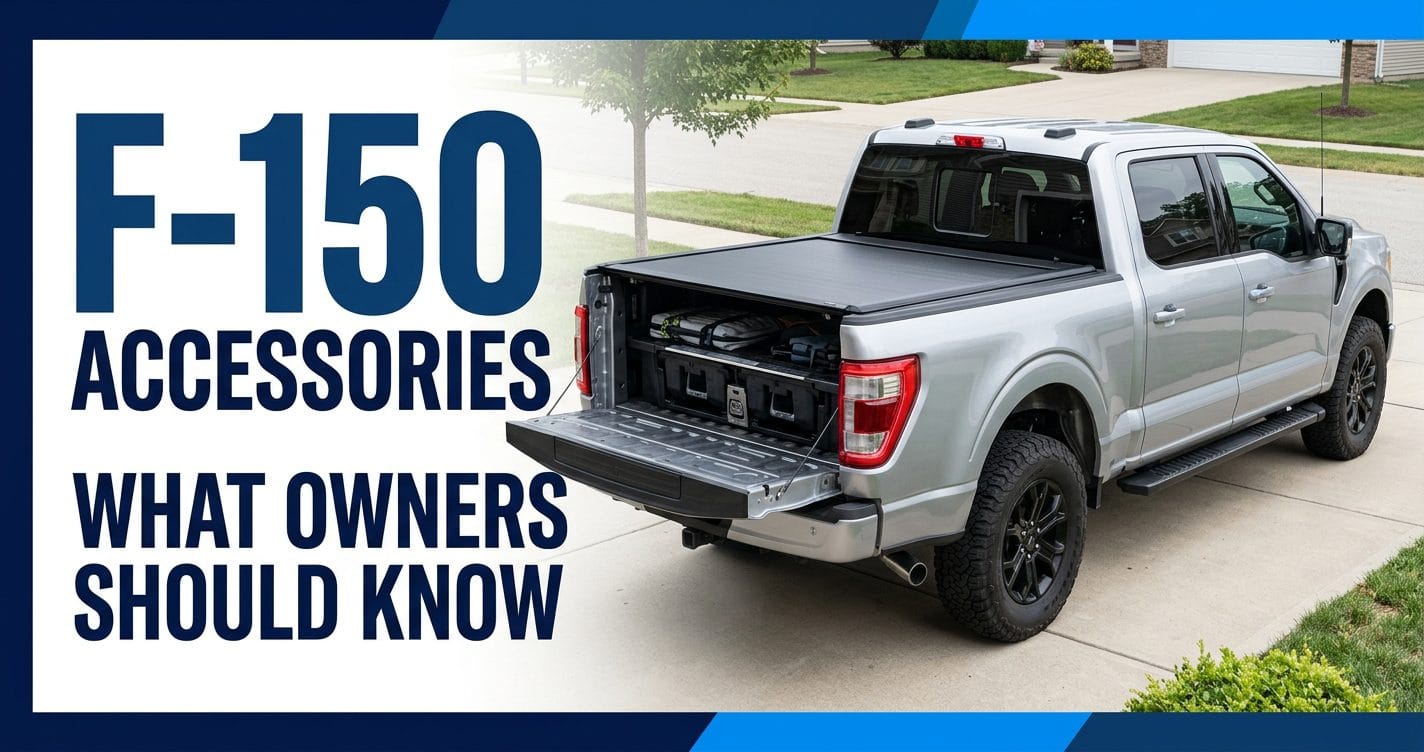
Ford truck accessories F-150 owners choose can change how their trucks handle daily commuting, work, weekend trips, and hauling. From all-weather floor liners to bed covers, running boards, storage systems, and lighting, accessories can make an F-150 more useful. But not every upgrade fits every truck, and some modifications can affect safety, towing, or everyday comfort.
In 2026, choosing accessories involves more than finding something that looks good. Modern trucks have different cab styles, bed lengths, factory technology, and equipment packages. Understanding these differences helps owners avoid compatibility problems and spend money on changes that solve real problems.
This guide explains the main accessory categories, what owners discuss online, how factory and aftermarket options compare, and what to check before modifying your Ford F-150.
What Are Ford Truck Accessories for the F-150?
Ford truck accessories for the F-150 are additional components designed to improve convenience, protection, organization, appearance, or specific work capabilities. Some come from Ford or its approved accessory partners, while others are made by independent manufacturers.
These accessories generally fall into three groups.
Interior accessories
Interior accessories help protect the cabin and make daily driving more comfortable. Examples include:
- All-weather floor liners that contain dirt, mud, and moisture.
- Seat covers that help protect upholstery from work clothes, pets, and spills.
- Console organizers that keep small items from moving around.
- Dash cameras that record the road and may provide useful evidence after an incident.
- Cargo organizers for keeping tools and personal belongings in place.
These upgrades may seem simple, but they can make a difference when a truck serves as both a work vehicle and a family vehicle.
Bed and cargo accessories
The truck bed is one of the F-150’s most useful features, but an open bed does not suit every task.
Common options include tonneau covers, bed liners, toolboxes, cargo nets, bed extenders, and rack systems. Each serves a different purpose.
A bed liner helps protect the bed surface from scratches and impacts. A tonneau cover can help shield cargo from weather and casual visibility. A toolbox provides a dedicated storage area for equipment.
However, a cover can limit access to tall cargo, while some rack systems occupy space or require specific mounting hardware. The best setup depends on what you regularly transport.
Exterior, performance, and utility accessories
Running boards make getting into the cab easier. Mud flaps help limit the amount of road debris thrown against the bodywork. Wheels, tires, grille changes, and exterior trim can change the truck’s appearance.
More involved modifications include suspension lifts, leveling kits, auxiliary lighting, and performance parts. These deserve extra attention because they can affect handling, ground clearance, tire fitment, electrical systems, or other vehicle functions.
The key distinction is simple: an accessory that improves appearance does not automatically improve capability.
Why F-150 Accessories Matter in 2026
The F-150 is used for a wide range of jobs. One owner might commute on highways, another might carry construction equipment, and someone else might tow a camper or travel on unpaved roads.
Those different needs explain why there is no universal accessory setup.
Ford’s official 2026 F-150 accessories catalog groups products into categories such as exterior, bed and cargo, interior, electronics, and wheels. Its listings also identify different cab and bed configurations.
That matters because two trucks with the same F-150 badge may not accept the same accessory.
Technology is another consideration. Newer vehicles may have factory cameras, sensors, electronic controls, and integrated towing features that need to remain functional after modifications. An accessory should work with those systems rather than interfere with them.
Owners should also consider long-term use. A durable floor liner or properly fitted bed protection may be useful for years. An expensive appearance modification may offer less value if it makes the truck harder to use for its original purpose.
Seven F-150 Accessory Categories Worth Understanding
1. Bed covers and cargo protection
A tonneau cover is a panel or flexible covering that sits over the truck bed. Designs include soft roll-up covers, folding covers, retractable systems, and full bed caps.
A cover may help keep luggage and tools out of sight and reduce exposure to rain and road debris. However, it should not be treated as a completely waterproof or theft-proof enclosure.
In a Reddit discussion about bed covers, owners described water entering around cover corners despite attempts to improve the seals. That illustrates an important point: a cover’s performance depends on its design, installation, and interaction with the tailgate.
If you frequently transport tall items, an open bed may be more practical. If you carry luggage or equipment, covered storage may be worth considering.
2. Bed liners and wheel-well protection
Bed liners help protect painted surfaces from abrasion caused by tools, lumber, equipment, and shifting cargo. Common designs include spray-in coatings, removable drop-in liners, and rubber bed mats.
A spray-in liner creates a bonded protective layer. A drop-in liner can be removed, but dirt or moisture trapped underneath may need attention. A rubber mat is relatively simple to remove and clean.
Rear wheel-well liners provide additional protection in areas exposed to road debris. They are particularly relevant for trucks that regularly travel on gravel roads or through muddy work sites.
The important consideration is maintenance. Even protective accessories need occasional cleaning and inspection.
3. Floor liners and seat protection
Interior protection is one of the least complicated accessory categories. Properly fitted floor liners help contain water, sand, snow, and mud before they reach the carpet.
Fit matters more than appearance. A poorly fitted floor mat can move around and interfere with pedal operation, so use the correct design and secure it according to the vehicle’s instructions.
Seat covers can protect upholstery, but they must be compatible with the seats and any airbag deployment areas. Do not assume a universal cover is safe for every seat design.
4. Running boards and side steps
Running boards provide a step along the side of the truck. They can be especially helpful on trucks with higher ride heights or for passengers who find the cab difficult to enter.
Fixed boards are relatively straightforward. Powered steps extend when needed and retract when not in use, but they introduce motors, wiring, and moving parts that may require maintenance.
Owners should consider ground clearance, winter road conditions, and the people who regularly use the truck. A step that makes entry easier on pavement might become an obstacle on rough trails.
5. Wheels, tires, and suspension changes
Wheels, tires, leveling kits, and lift kits are popular ways to change an F-150’s appearance and driving characteristics.
However, larger tires may require different wheel dimensions or additional clearance. Suspension changes can affect alignment, ride quality, steering geometry, and how the truck behaves under load.
A lifted truck is not automatically a better towing truck. Changes to ride height or tire size do not increase the vehicle’s certified payload or towing ratings.
Before making these changes, consider how much highway driving, towing, hauling, or off-road use the truck actually sees.
6. Lighting and electronic accessories
Auxiliary lights, dash cameras, phone mounts, charging equipment, and additional electronic devices can improve convenience when installed correctly.
Electrical accessories need appropriate wiring, fuses, mounting, and power management. Poor installations can cause electrical faults, battery drain, or interference with existing systems.
Lighting also needs to comply with applicable road-use regulations. Brightness alone does not determine whether a light is appropriate for public roads.
For newer trucks, compatibility with cameras, sensors, and factory controls should be checked before installation.
7. Towing and cargo-management equipment
Hitches, trailer brake controllers, towing mirrors, cargo tie-downs, and rack systems support specific hauling needs.
These components must match the intended task and the truck’s existing equipment. A hitch’s rating alone does not establish how much the complete truck can safely tow.
Ford’s towing guidance explains that towing capacity varies with configuration, equipment, passengers, and cargo. Owners should consult the towing guide for their specific model year and the ratings on their vehicle.
For more background on truck capability and modifications, see our guide to RAM truck towing.
Factory Accessories vs. Aftermarket Accessories vs. DIY Modifications
The table below compares three common approaches. On a phone, swipe horizontally across the table to view all columns.
| Factor | Factory or Ford-approved | Aftermarket | DIY modification |
|---|---|---|---|
| Fitment | Often listed for specific configurations | Depends on the maker’s compatibility information | Depends on the parts and installation |
| Product selection | Limited to the catalog | Broad range of designs and prices | Depends on available materials and skills |
| Installation | May include vehicle-specific instructions | Instructions vary by manufacturer | Requires the installer to understand the work |
| Warranty considerations | Still subject to specific warranty terms | May affect coverage for damage caused by a part or installation | Poor workmanship can cause damage |
| Electronics integration | Compatibility may be documented | Must be verified carefully | Wiring and system integration can be challenging |
| Main consideration | Confirm exact vehicle eligibility | Verify fit, quality, and support | Assess safety, tools, and technical skill |
Neither factory nor aftermarket automatically means perfect. A genuine accessory can still be wrong for a particular cab or bed, while an aftermarket accessory can work well if it is correctly designed and installed.
DIY work may be reasonable for straightforward tasks, such as placing compatible cargo organizers. Suspension, towing, structural, or complex electrical modifications deserve a more cautious approach.
What F-150 Owners Are Saying Online
Owner forums and Reddit discussions offer a useful view of how accessories perform outside a catalog. They are anecdotal rather than controlled tests, but they can highlight problems worth investigating.
Practical upgrades often come first
In a discussion among first-time F-150 owners, participants mentioned items such as floor protection, running boards, dash cameras, and bed covers.
The broader lesson is that useful accessories depend on everyday routines. A person who drives to construction sites may value washable liners, while a family that travels with luggage may care more about secure cargo storage.
Compatibility problems can outweigh convenience
Owners discussing bed covers and rack combinations often focus on fit, access, and whether the components work together. A cover that interferes with the tailgate or a rack that blocks access to cargo can become frustrating even if each component works as advertised.
Read owner reports for recurring patterns rather than treating one person’s experience as universal proof. Check the model year, bed length, and installation details in each discussion.
Better protection does not mean zero maintenance
Bed covers, liners, and exterior accessories still need cleaning and inspection. Seals can wear, fasteners can loosen, and dirt can accumulate in areas hidden from view.
This is a useful reminder for anyone modifying a truck: accessories add responsibilities as well as benefits.
How to Check Compatibility Before You Modify Your F-150
A few minutes of checking can prevent an expensive mistake.
Confirm the model year and configuration
Identify the truck’s model year, cab style, bed length, trim, and existing equipment. Do not rely on the phrase “fits Ford F-150” alone.
For example, a cover designed for a 5.5-foot bed may not fit a 6.5-foot bed. Tailgate designs, factory storage systems, and mounting points may also affect compatibility.
Check load limits and towing requirements
Ford’s 2024 F-150 towing guide lists maximum towing of up to 13,500 pounds and maximum payload of up to 2,445 pounds for particular configurations. Those figures are not interchangeable, and they are not the ratings of every F-150.
Payload includes occupants, cargo, and applicable equipment carried by the truck. Trailer tongue weight also counts toward payload.
Use the door-jamb information and the correct model-year towing guide rather than relying on the highest advertised number. Adding heavy accessories reduces the remaining capacity available for people and cargo.
Consider installation and future maintenance
Before installing an accessory, ask:
- Will it interfere with cameras, sensors, airbags, pedals, or factory controls?
- Does it need electrical wiring or special mounting hardware?
- Will it restrict access to the bed, tailgate, spare tire, or service points?
- Can it be removed without damaging the truck?
- Does the installation affect any applicable warranty coverage or vehicle regulations?
Ford’s official towing information is a useful starting point for checking towing requirements.
What This Means for Truck Owners Going Forward
The smartest approach to F-150 accessories is to start with a problem, not a product.
If muddy boots are ruining the carpet, interior protection solves a clear problem. If tools are exposed to weather, bed storage may help. If passengers struggle to climb into the cab, running boards may make everyday use easier.
More complex modifications need a different level of planning. Suspension changes, oversized tires, towing equipment, and electrical accessories can affect several parts of the vehicle at once.
It is also worth looking beyond Ford-specific information when researching general truck maintenance. Our guides to RAM 1500 accessories and daily-driver truck upgrades discuss similar questions about protection, comfort, and practical use. The vehicles differ, so their specific parts and fitment requirements should never be assumed interchangeable.
The goal is not to build the truck with the most accessories. It is to make the truck work better for the way you actually use it.
Key Facts at a Glance
- Fitment comes first: Check model year, cab style, bed length, trim, and factory equipment.
- Start with practical needs: Floor liners, cargo protection, storage, and access improvements may solve everyday problems.
- Bed covers have trade-offs: They can help protect cargo but may limit access and do not guarantee a watertight seal.
- Modifications can affect capability: Larger tires, suspension changes, and added equipment require careful evaluation.
- Towing and payload are different: Always verify the ratings for your specific truck and equipment.
- Installation matters: Incorrect wiring, mounting, or placement can introduce safety and reliability problems.
- Owner reviews are useful but limited: Look for repeated experiences and verify important claims against reliable documentation.
Conclusion: Function Should Come Before Appearance
Ford truck accessories for the F-150 can make a good truck more comfortable, practical, and better suited to specific jobs. But the best modification is not necessarily the biggest, most expensive, or most eye-catching one.
Choose accessories that solve a real problem, verify that they fit your exact truck, and protect the vehicle’s original safety and capability. That approach is more useful in the long run than buying upgrades simply because they are popular.






0 Comments